
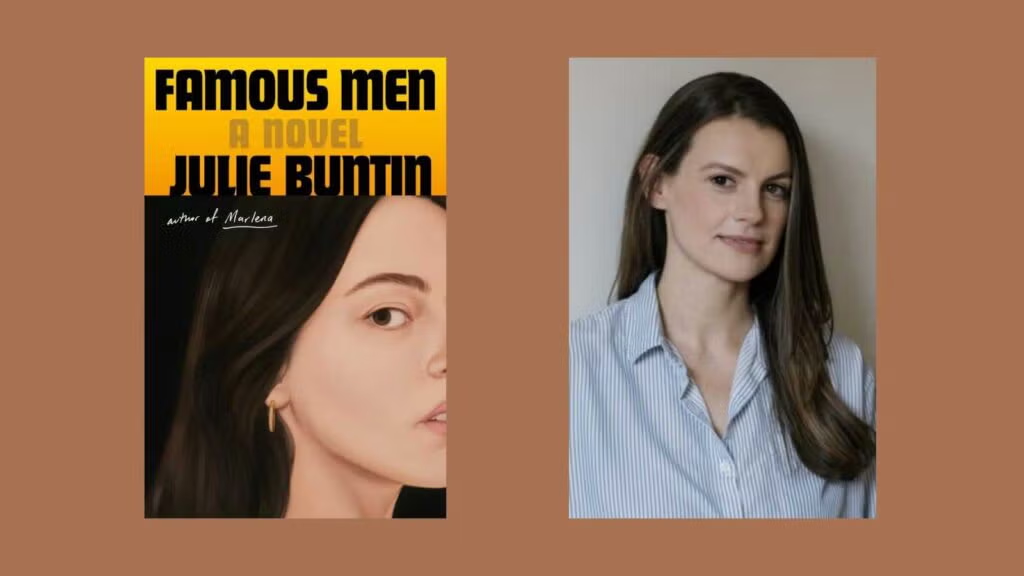
Julie Buntin’s Famous Men is an ambitious and arresting novel that takes up the complicated intersections of desire, power, and art. The book follows the journey of Wilhelmina Miles, or Will, an ambitious, young woman on a quest to find the father she’s never known and discover her potential as a writer. After a difficult adolescence in Michigan, Will moves to New York for college and to seek answers from accomplished writer and professor, Nathaniel Fellow. She quickly falls into Nathaniel’s world of the literary intellectual elite while their relationship takes a sexual and precarious turn.
Buntin constructs time, memory, and perception as pressurized forces in Will’s coming-of-age as a writer. While rooted in the tradition of a Bildungsroman, the novel complicates a familiar arc of growth and self-discovery. As Will comes into her own, she is eventually forced to confront the moral complexities of being absorbed into such a world and into the orbit of such a man. What emerges is an honest exploration of how victimhood and complicity can become entangled.
Buntin is the author of Marlena, which was a finalist for the National Book Critics Circle’s John Leonard Prize and longlisted for the Center for Fiction’s First Novel Prize. Her collaborative nonfiction project, Notes to New Mothers, co-edited with Rebecca Dinerstein Knight, will be published in September by Norton. Buntin is an assistant professor at the University of Michigan.
This interview was conducted in person and has been edited for length and clarity.
Priya Pai: As Will grows up in Michigan, she encounters men watching her at all times. When she moves to New York, she tries to wrest control of the male gaze to see if she can use it to her advantage. There is also the gaze in terms of Will becoming a writer and noticing the world. This ends up becoming mediated by Nathaniel and by her status as a woman writer. How did you think about the dynamics of looking and being looked at in this novel?
Julie Buntin: That tension between being seen and wanting to do the seeing is interesting to me. I don’t really write toward an answer. I write toward questions and I find more questions along the way. Will wresting control through leaning into the male gaze is something that she starts to do because she’s been almost groomed by her circumstances to consider that as the only way to get proximity to power. And that mistaken kind of decision-making creates results in her life. It moves her towards the goal in some weird way. I was thinking about what that would mean and if you would ever be able to escape that. Can she really turn her own gaze back on that when she’s sort of trapped within it?
Also, Will’s a character has her own limitations. She’s self-aware in some ways but she’s not coming into the situation with Nathaniel with a lot of sophistication, which he very much knows.
Coming up against that too is the challenge where I have a different feeling about the things she does and sees and doesn’t see than she does. Trying to navigate that delicate space as a writer of inhabiting a character in a first-person voice while also using parts of my own background even as she, in many ways, departs from me, all became sticky too. Whether Will would have gotten where she does in her writing life another way is up to the reader to weigh.
PP: Your debut, Marlena, oscillates between past and present as the main character, Cat, makes sense of her grief. I was interested in how time works in Famous Men too, especially as we see Will grappling with the influence of Nathaniel and men in general as she comes into her own. This novel is much more linear and it’s very sprawling, spanning so many eras of Will’s life. What drew you to this larger scope of time?
JB: With this book, I was interested in the question of how time works in a novel. Something I love is reading a book for a week but feeling I’ve lived for 17 years, that sense of a book being a portal not just into another world, another life, but to a different experience of time itself. This is one of the magic tricks of fiction. I don’t think I did that really with my first book. [In Marlena], the temporal containers are really tight. Famous Men ends with a character in a different place that is kind of like the place where she starts, but I really wanted to take the reader on a journey. It felt like a real challenge. While writing, I was reading and rereading a lot of classics, especially Dickens, specifically Great Expectations. I read that multiple times over the course of writing Famous Men. Dickens is a writer whose work I take great pleasure in. He has a vexed relationship with women in his real life and in the fiction itself—he is another writer I love whose representations of women are sometimes challenging for me. Great Expectations, though, is a book that starts with Pip as child and ends with him as an adult. Pip’s voice is retrospective, so he can comment on the mistakes he’s making as he makes them, but we still inhabit his misguidedness as it unfolds. I was trying to see if I could do something like that.
When you’re writing a novel that unfolds over many years, it’s tricky to know when to constrict and when to dilate certain moments in time. It felt crucial for the story I wanted to tell to start with Will as a young person, before she meets Nathaniel. That was the hill I was going to die on if people were going to tell me to cut it. The broad strokes of the plot of this novel are familiar. You can say, we’ve read this before, but some of the decisions I was making around when we meet Will and how we meet her were my way of trying to tell not exactly a new story, but a story we think we’ve heard before in a new way. Then, that means what do you show and not show? What do you cut? I almost thought of the novel as a series of novellas of moments in Will’s life, and the cuts happening between them. There’s the childhood novella and the New York novella. We meet her again once her relationship with Nathaniel starts. We meet her in moments of living with him or departing from him.
Then, there is the second person section, which is my way of essentially trying to find a narrative approach to time that would allow me to give the reader a sense of a character who has slipped off the track of her own life. I see those pages as trying to evoke that feeling I think so many of us have had in our twenties, when you’re like, wait, it’s been three years since I started this job, now five, this feeling of a character who’s swept up in the current of time, of life, with no ability to gain control. I felt like second person was an interesting vehicle for that. I could compress a lot of time really fast, and I felt that would be more emotionally effective than just cutting from when she’s in her early 20s to her late 20s. I was thinking about when the house falls asleep in To The Lighthouse and these moments in books where there’s a rupture, not just in terms of plot, or character, but in the text itself.
These were all different ways I think of playing around with time, ultimately, in the hopes of giving the reader that sense of having lived alongside someone over a small lifetime. This was an effect I wanted to go for to maybe show a relationship like this outside of the more predictable novelistic container of the explosion and the immediate aftermath. Instead, I wanted the long buildup and the long tail of it. Relationships like these—they aren’t contained. They can spill across your whole life.
PP: Yes, you mention Great Expectations, and I noticed Famous Men follows a theme of a Bildungsroman. However, it places a neat arc of growth into question, and it’s self-aware of circular narratives. Were you interested in complicating the coming-of-age tradition in some way?
JB: A few questions I hope readers sit with at the end are: did Will change? Did she grow? If she did, why and how? Some of this book is a reaction to received rules about how to tell certain kinds of stories, a way of exploring some frustrations I’ve felt around what we need from victims, what we expect from a story or a character in order to take their side, to empathize with them.
I do think Will’s passivity—at least in a kind of “craft of fiction” sense—poses a bit of a challenge to the traditional Bildungsroman. What does it mean to come of age for a character like Will, who has so much self-determination and so much agency so early on? She goes in pursuit of Nathaniel, she leaves home, she does all these things that are hard and quite active, but then she gets stuck in a system that re-channels that agency in potentially destructive ways. A lot of her life goes by with her trying to be a writer so hard that she no longer does anything else. Instead, there’s a kind of passivity that enters her daily existence, where she’s putting her whole life on pause and rolling along with Nathaniel, or even her friends. In the context of a coming-of-age story, we think of characters as going out and building their own lives. Will’s almost trying to stay very still. But, I think so much of my experience in the world has actually been about moments when I didn’t do something or couldn’t do something or didn’t even understand that I wasn’t doing something. That kind of passivity felt so sticky and hard to capture in fiction, so fraught. I think I was attracted to that in part because a passive main character was one of the biggest writing taboos when I was an MFA student. Passivity in fiction is like a dead zone. It’s very hard to write an interesting book about passivity, to get the reader to care about a protagonist to whom things just happen. So I was trying to build a container that would be compelling, even as it broke some of the “rules.”
PP: I want to talk a little bit about memory. In conversations about trauma and abuses of power, memory is often contested and survivors’ recollections are frequently cast as unreliable. I noticed in the first section there’s a reference to where Nathaniel would have started the story versus where Will decides to start the story, what he might remember versus what she remembers. How did you consider memory and unreliability when you were thinking about the novel?
JB: I thought about it a lot. One of the things that haunts Will and really has a lot bearing in different ways on her decision making across the book, is a question Will doesn’t ask explicitly until the end of the novel. Without giving away any spoilers, I’ll say it has a lot to do with her mother’s memory, of what Will has to accept about that. When is memory something that we do to protect ourselves from what we don’t want to face about who we are? Or from what we don’t want to—or can’t—face about what happened?
There’s another layer here, which is: what happens when we tell the story? What happens when we write the story? There’s also a sort of metatextual plane in this book about the question of what it means to fictionalize something that started somewhere true…[a] knot of questions which are still questions I have about the world, about things that have happened to me, about things I’ve seen or lived. The only way I know how to try to make sense of that is to try to write towards it, but I don’t know that I have come to any answers. These kinds of questions about memory and trauma and truth, who needs to tell what version of what story, and of course who gets to tell the story, were all these dangerous live wires that I wanted to write toward.
PP: We’ve discussed perspective a little, especially the section set entirely in second person, as ways to manipulate time. I felt that the novel is also using perspective to call awareness to directives and advice given not just to women but writers in general. Can you talk about how you were considering and using point of view in the novel?
JB: Yes, there’s this way that second person can feel like a bunch of commands. Will is in a situation where she is the recipient of one channel of advice. How that changes her self-talk, even her sense of what’s real, what matters, what’s truly happening, was interesting to me. There’s another section later, “Office Hours,” which [includes] things that Will has heard Nathaniel say that just she can’t get out of her head, and we don’t know when she’s heard them. They’re things she’s heard in different contexts over time, and I wanted to create this feeling of bombardment, accumulation, how the build-up of all this stuff just jammed up her brain.
I was thinking a lot about the complexities of teaching and mentorship, especially in the context of creative writing, which is not like teaching somebody geometry, where there’s a set of rules. The work we do is inevitably entwined with how people think about themselves, where they come from, who they want to be. I had a new awareness when writing this novel about how vulnerable that is. Not everybody takes that responsibility seriously and how damaging that can be, even accidentally.
I can think of things that were said to me in my MFA program that are still stuck in my head. My professors may have just been tired, making a few comments before going back to their work or to pick up their kids or whatever. But I still remember. The stakes can be so high in these settings. Second person and plays with perspective were ways of approaching that or giving the reader a sense of that feeling and embodying it on the page.
PP: Yes, there’s a lot of advice that Will is given, and I was interested in how it intersected with the ways of the correct way to be a woman, the correct way to be a woman writer. I appreciated the overlap of that. Will is kind of a vulnerable person who’s moved to New York without class privilege and institutional privileges her peers have in this MFA space that she’s part of, but not entirely part of. When you’re in that position, it’s striking how much those directives end up meaning intentionally or unintentionally.
JB: Yeah, and she just doesn’t have as many competing sets of directives, the way Lili might, either to provide a counterpoint, or to challenge something, or maybe even the confidence.
PP: Class disparity is a large part of what Will is dealing with, but she also has this heart condition, which is an illness that is kind of invisible. It’s at times only apparent to her and, of course, creates even more economic instability, as she deals with mounting medical debt. Could you talk more about this choice to give her this condition?
JB: I was interested in a character who has been conditioned to not trust what she perceives as true about what she feels, or even about what has literally happened. From very early in the book, Will doesn’t know what happened with the boys in her high school. She has a sense that she’s being watched long before she gets the confirmation that she is being watched. When she does get the confirmation, she doesn’t know how to interpret it. She’s like, what kind of harm is this? How bad is this? What does it mean? How bad am I allowed to feel? Is this in some way my fault? She also doesn’t know who her dad is, and no one will tell her anything about him. Not only that but they won’t even acknowledge her curiosity. It was a familiar dynamic to me from having grown up in the rural Midwest, of what we talk about, what we don’t talk about, what we acknowledge, who gets to complain about things, who doesn’t.
As I shaped the novel, escalating Will’s dependency on Nathaniel became an important element of the plot. I needed to have external reasons why she gets in over her head. One way of doing that was debt. It also felt resonant to give her some kind of illness that was the physical manifestation of gaslighting or something that could be misconstrued as anxiety, or a panic attack. But—to be honest—I also have this heart condition. And it’s no secret that in my fiction I’m drawn to experiences I’ve wrestled with in life. I know how expensive it is, how easily dismissed it is, how scary it is, and I’ve definitely lived the question that haunts Will in so many spheres of her life: Why is it so hard to trust that what I feel in my body is true?
PP: I noticed many of the section titles in the novel are quotes from poems, like Kate Marvin’s “Lying my Head Off,” Philip Larkin’s “Home Is So Sad,” Mark Halliday’s “Bad People.” Obviously, this is in line with Will’s identity as a poet, but I was wondering how you chose the poems and how they may have helped to structure the novel.
JB: I wish I had a good answer! When I would read one [a poem], I would just know. They were the easiest part of this book. In my previous answer I talked a bit about plot strategy—escalation. There are times in the drafting of a novel where you just have to solve problems, figure out where to put nails, etc. But there’s a way that two things can be true at once as a writer. Sometimes I have the feeling while writing that my characters just do things, and I just follow what they do. And then sometimes, I’m like, that’s bullshit, every decision I’ve made, I’ve made really carefully. But for those [section titles] and the epigraphs, too, most of them were remembered lines or phrases that just felt right for the sections. Like “A Bedlamite Speeds to Thy Parapets.” That just captured everything about the early New York stuff for Will. Same thing with the Mark Halliday. I was reading that poem, and I was like, oh yeah, this is the line. Sometimes the poems intersect in some way with the plot, but really, it’s more a tonal thing. The Philip Larkin line just walked into my head. I love that one. I mean, you can probably tell, I take great pleasure in the language play of some things, and this was just one of those ways of doing that.
PP: You’ve mentioned Great Expectations by Charles Dickens and Zuckerman Unbound by Philip Roth as influences for the novel. What other books, films, or artworks were informative or inspirational to Famous Men?
JB:
Trust Exercise by Susan Choi. My Education [by Susan Choi] was also an important book. All her work really. In terms of nonfiction, Life with Picasso by Francois Gilot, which was about a woman who was in a relationship with Picasso in her early 20s. Darryl Pinkney’s memoir about Elizabeth Hardwick, Come Back in September. Sigrid Nunez’s Sempre Susan, which is not about a relationship like this but is about idolizing another writer. Difficult Women by David Plante. Some books about writing too. In terms of film, I remember one thing I tried not to watch, when working on the book towards the end: After the Hunt.
PP: What was the revision process like for this novel? Were there any revelations, story lines, or character shifts that came as a result?
JB: I started the book in 2019. I feel like I finished it at two points. I sort of finished it before my daughter was born, but then really finished it after she was born. So, I finished it in 2024 and then did yet another big revision.
There was a period after my son was born, when I was two-ish years into the book, where I got stuck again, and I didn’t really want to write. I had a hard time after he was born doing anything. When I did get back into the book, I found it really hard to connect to people in their 20s. I was writing fiction, returning to the world of Will, and the concerns of Will, and the concerns of young people trying to make art, when I didn’t want to be making art, and I didn’t feel young anymore, and I had this baby. I felt really alienated from the project.
During that time, I wrote an entire section of the book from Lili’s perspective after her son was born. [It was] a 120-page novella about Lili dissociating, her conflicts with her husband, her frustration with her friend who was having success, where Will is just a side character. That was a confusing detour because I was sharing it in my writing group which has a lot of moms in it. I was getting a lot of positive feedback because it was mom stuff. Then, I showed it to my editor and my agent. They were both like, um, we don’t really get it, but we trust you. I was like, okay, they like it! And then I just spent a year trying to make that happen, but I couldn’t stitch it up. I tried to essentially activate the middle section of the plot, the Lili stuff with the article. I tried to tell it from Lili’s perspective and then meet Will again in a third act. It just wasn’t good. I don’t know how else to put it. All of the tension of the book leaked away. It was too weird of a detour. It didn’t sharpen any of those questions. It just added a ton of new questions. It wasn’t satisfying because you wanted to know what happened to Lili, and you didn’t understand why you didn’t meet her earlier. It wasn’t right, but it was so hard to say, “I’m gonna put this away.” When I did, I essentially had to rewrite the book. I had this whole middle movement that wasn’t in the right perspective. So, I printed it out and retyped from the beginning. I did that in 2023 or something. That was a long time-consuming wrong turn, and I don’t even know what to say about it. It’s not an efficient way to write a novel, and I don’t recommend it.
I really think people should start books, write them until they’re done, and then start the second draft. But you also can’t control if you have a baby or something about your life really changes. You have to stop and bring your new self to the book. That person has to be accommodated too.