
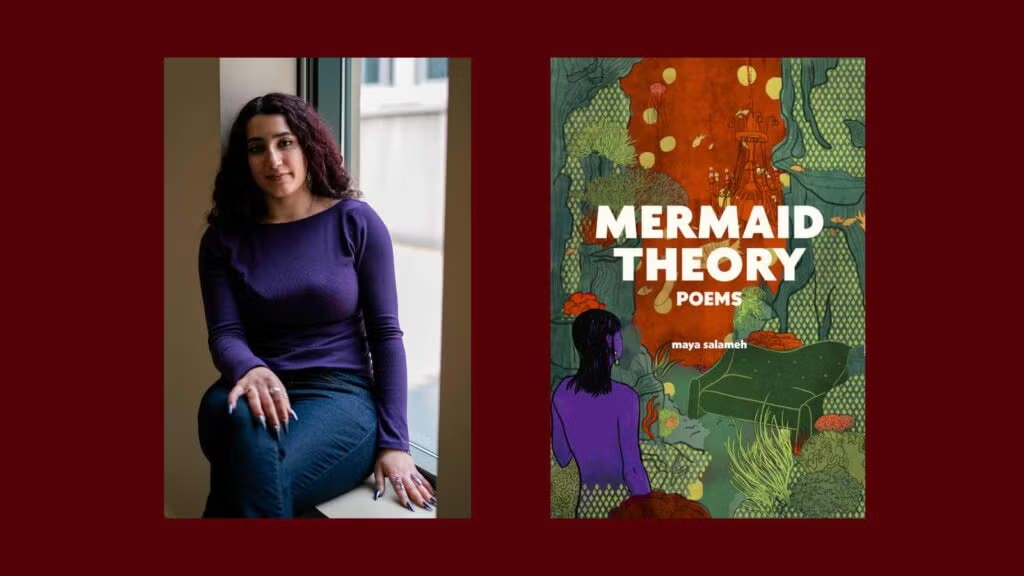
Maya Salameh’s collection of poetry, Mermaid Theory, is out today (April 7, 2026) from Haymarket Books.
HAGGLING THE SHAMI WAY
MAYA SALAMEH
Everyone loves older men and even older cities. But women must be girls, and preferably girls from out of town. But I’ve lived here my whole life. -Sennah Yee, “BOND ‘GIRLS’ PT. 1: LUCIA”
*
In June of 2022, the week after my college graduation, our family returned to Syria. We flew into Beirut because Israel bombed the airport in Damascus again.1 I bought gummy Skittles and popped a cloud every hour we fermented at the southern border: lemon, blueberry, lime, red. Baba hadn’t brought our birth certificates or acquired us visas, and our swollen faces don’t serve as sufficient proof of Sham. We spend our first morning in the homeland driving to Kafroun, Jiddo’s village; spanning the roads are long blades of grain, crucifixes in the ground, checkpoints upon checkpoints tilled by men who are boys still. Jiddo is mama’s baba. He has papery skin and a ruddy smile. He is a sturdy 78. He introduces my brother and me to his fig trees, his plums, the vineyard he’s devised on the roof. He walks us to the creek sourced from the river descended from the mountains. The rocks are slick with moss and cigarette butts.
*
In my mother’s childhood home, I find pictures of her with hair dyed russet and piled high, eyes lined with kohl, all the attitude of a woman no one’s called mama yet. I look at her now returning with American dollars and unhenna-ed roots and her children who speak with the hesitation of tourists. She is about five foot four. When she leans over the sink to rinse rice, her shoulder blades poke through her shirt like prayer wings. Down the street, mama’s cousin tells us about her husband, shot in his study eighteen months ago. She folds her hands the way widows do, describes the hole in his occipital bone and the mabrouks which littered her son from 2012 on. Martyrdom was still rare at that point in the war. Her eyes don’t glimmer. They are a river with no source.
By the fourth day of our return, finally in Damascus, my sister and I wake up sick as dogs. I convince Baba to buy me an anklet even though he’s scared they’re for ra’assat because Do I look like a dancer? I just got my master’s, and his friend discounts the silver. Baba turns a soft red in the sun. His mercury fillings click when he eats fruit. We stroll through the souk and each vendor appraises us gram for gram. Only Mama’s walk really has Sham in it. My temples protest the entire first week as I long for Palo Alto, its clinical organization and wide roads and lawns trimmed like spreadsheet cells. I miss my girl and my boxy room. On Father’s Day I throw up and buy another anklet, this time with small beads tinted like variegated lilies. Lots more 7UP. Baba says it is essential to witness others’ pain.
*
By the second week, the rhythm of our days softens. Around dusk, my sister puts on her long velvet dress and finally I rise from our shared bed and tweeze the side of my face, preen with the blue liner I bought. A sister’s beauty is contagious like that. Crushed velvet frames her lovely fair skin which everyone here comments on. Rayon the color of sky showcases my less fair skin which everyone here comments on. The two of us as girls, baidah w samra. Baidah w samra still, we share a vodka cranberry, ignore that last night we fought over the last of the hot water, the largest towel in the linoleum bathroom. Tonight we’re quiet, leaning toward each other in the gold light, passing the green hookah hose back and forth. We gaze at the Mediterranean which taught us to swim. I was four, Baba dropped me in the water; I learned to tread. The water was the widest thing I’d ever been taught. In my chest wasps, moths, timid flies.
*
The locust is a species resistant to known predators.2 I am a phylum of my own, extinct for six hundred years already. Participant background: the skin of my killer is seated first on airplanes, especially when their navy uniform is starched. In sunny San Diego where I grew up, most of the men who approach me are soldiers. They try impressing me with new white Chevy Silverados, free college, the wide pensions the ROTC kids in my calculus class count, ripe fruit plucked from corpses that look like me. My hometown is nicknamed America’s Finest City and the weather looks real good and so do the men.
In another timeline, I don’t need to explain my blood to the handsome scientist. No crusaders rolling, pushing, and developing my corpse towards California, no long arc of history explaining the chronic conditions on my university intake form. I’m a good animal.3 I’m well-vaccinated, compliant, complaining of womb aches, migraines, moroseness. I sear lamb, brown broccoli heads in the skillet. I want to write down this maroon haunt I’ve inherited, the thing that blooms behind my molars when someone says home like it’s a clean word. I want to pin it against the wall and make indentations in its back with my nails. But I’ve painted them cream and they glow in the dark and I think that would frighten a cryptid of that size.
For now it’s still Damascus, we’ve hit our third week, I start acclimating. We spend our days visiting kin, shuttling from apartment to apartment, the fountains in the hotels we can’t afford ancient and creamy marble. On every street, the sound of too-young children selling roses. Most are unaccompanied. Teta asks me if I’ve ever been in love while I cut my hair in the mirror. We stand in the bathroom together while she paints her lids gold. This is the best language we have in common. We gossip about the other church girls and how رغد’s daughter is two thirds of last summer’s weight. The night falls on us around nine, and I start reclining into my Arabic, its skirts molding to my palms. On the second floor of our hotel, all the rooms are reserved for UNRWA workers that never come. Their signage eyesores the lobby. No AC so I listen to the music of cicadas while I wait for the heat to abate so I can sleep. I am molting, but I don’t mind. I want something ancient to touch me back.
The next day, on a morning blurry with humidity, we visit the Bimaristan al-Nuri in al-Hariqa, one of the oldest hospitals in the world. It has a stone archway with a sultan’s name carved above it and my palms touch cold muqarnas. At the center of the courtyard is a fountain meant to calm patients. The walls have craters in them from unknown combatants. Here, illness was treated with enough to eat, music, spiritual and somatic treatments. I try to believe kindness once lived here as policy. I try to believe someone once left cured. I touch the inscriptions in the stone and think this is what I hope my children inherit, rooms echoing with the footfalls of students, diagrams of the nervous system, the free healing of strangers. It smells of cedar and antiseptic.
*
The first language I practice upon my return to America is the body. I listen to Tiny Desk concerts stoned. I cook breakfast in the sunny sublet, dice green onions. I try putting myself to sleep by hand, by reading. But my sternum emits jasmine and petrol, my body for weeks dehydrated like it remembers its nativity. Back there, over there, over my body, Israel bombs the airport in Damascus three times. Israel pokes its heels into the Golan. Israel rots my grandmother’s food in her fridge. The war is over, but it’s not. It’s changed skins and tactics.
No ocean, however tumultuous it may be, can give us an idea more exact (and moving) of water than does the smallest little stream in the gardens of Damascus.
—Etel Adnan, letter from Murcia, November 10th, 1990
*
In Baba’s hometown, we bicker in the chalet, the restaurant, walking past the gutted construction projects with pink bougainvillea climbing their ribs. I snip at my sister over the adapter we have to share because I’m the only one who remembered to buy one. Before breakfast, I lecture my little brother about astrology, how height-increasing insoles are in fact a red flag. I offer him sun and moon and rising. We give our birth times to my algorithm, wall in piles around the bed. The chalet has no working doors, but the pool is rich cerulean and eight feet deep. The air in Trablos is briny and generous, and the dumpsters throughout the city remain saturated as loam, just the same as in 2015, though the pollution’s worse and more fish are poisonous to eat. The gutters glimmer with diesel. My witnessing teems from my throat and my belly.
While we drive to the Hallab store filled with cantaloupe ice cream, 2ashta ice cream, mulberry ice cream, we argue about who is responsible for the roads being closed off. Mama’s friend accuses the Americans, my grandmother the Russians, and Mama’s sister’s neighbor blames the Kurds. Baba wanted to take us to Palmyra, but the cab driver says the route there from the border is still controlled by ISIS. I’m not sure how to write about this. At the risk of being a native informant about the circumstances of my life, at the risk of sounding Orientalist, at the risk of sounding American, at the risk of sounding Arab, at the risk of sounding alive–the facts don’t save us. But they might say we lived.
*
These were the facts: I was the eldest daughter of a Syrian mother and Lebanese father, born the August before 9/11. I started kindergarten speaking mostly Arabic. I spent every summer in Damascus until 2011. I started high school watching White boys debate it, and our women kept disappearing. Our women kept piling into boats headed to Greece and no one looked for them.4 I live twenty minutes from the Pacific now. Baba didn’t want to leave Lebanon. A car bomb went off across the street from him. He almost died. He got a scholarship from a university in Michigan. He worked as a grocery store bagger, a chauffeur, a dog walker, and a car parts assembler. He screwed the handles on the doors of shiny new Fords. He earned his doctorate in psychology. He wrote his dissertation about humor. When he moved to San Diego, he avoided the Pacific. He told us the Mediterranean was too beautiful. He told us America was good to him. In his free time, Baba collects coins. Somewhere, the cryptid is growing wings.
*
It’s June in Damascus and no poetry can equal it. The souk ceiling is the color of charcoal, it is addled with bullet holes. Mama still barters like she’s Shami, arguing unnecessarily over the cost of each smell we take home: ward, yasmeen, dara2. Long COVID has emaciated my sense of smell but the tinted oils still work as protective armor. In Palo Alto, and Damascus, and Beirut, I grieve minutiae. I wear the notched black blouse mama said made me look like an angel. Mama, whose moods bloomed like bruises across our days. I dream of bumping into her on the way to the bathroom without flinching. Coming home to her screaming or laughing you forgot to take the chicken out.5
It’s mid-August now, and mama’s tested positive for the virus, refusing any more medicine. My brother and father are asymptomatic. On FaceTime, I watch my exponentiating brother make our father eggs, his promise of shoulders hunched over the stove. Mama, who sleeps on the floor for her discs, turns down amoxicillin. Maybe the pain is exonerating, maybe another language in common. In my studies, I’ve learned that keeping secrets is actually very bad for your health, even causes autoimmune conditions. I recite all the cities hidden in my throat. Boston/Grass Valley/Trablos/San Juan, tucked neatly beneath my diaphragm. I remember my sixteen-year-old self riddled with MRIs, recommendations for counseling, Saint John’s wort, birth control. What ends up solving the migraines is Massachusetts; a damp rain from two Augusts ago; Victoria’s cherry-red Altima; playing Summer Walker until we believed we were young again.
*
In Lattakia the last week of our trip, desperate to ignore everybody, I joke with the sun, trade secrets with the sea in the way that extends my life. I find sweetness in the mahogany desks engraved with mother of pearl at the silver market, the geometry of speckled cement making the 3abbasiyeen, the etchings on balconies. I think no one can really understand grief unless their mother spoke Arabic.
Part of the grief of this distance is smoking lavender and chamomile and roses. Burning the things you’d boil for me, Mama. Repeating to myself: Control is the opposite of love. Control is the opposite of love. Sometimes, the drought picks me up from school. Sometimes I’m thirteen again, listening for the melody of floor submitting to feet. Most days it’s three o’clock, and I’m hungry for jerky or fruit or worried I’m not just ovulating or trying to prove I’m not a trousered swarm of bees. But there’s still eating a pomegranate with all of your hands, and learning to listen to yourself takes a long time. Long ago we crawled out of the water. We can’t go back. The chalet’s walls are perforated. I stare at my phone with my volume off. I try to mime the words I love you without choosing who I mean.
- “‘Heavy’ damage to Damascus airport confirmed after Israeli attack,” Al Jazeera, Jun. 11, 2022, https://www.aljazeera.com/news/2022/6/11/syria-says-significant-damage-to-airport-from-israeli-strike.
- In 1926, French and British mandate authorities reached an agreement with Turkey to prevent locust swarms in Syria. The agreement founded an International Bureau to fight locusts, based in Damascus. See Idir Ouahes,“French Mandate Syria and Lebanon: Land, Ecological Interventions, and the ‘Modern’ State,”in Environments of Empire: Networks and Agents of Ecological Change, edited by Ulrike Kirchberger and Brett Bennett (Chapel Hill: University of North Carolina Press, 2020), 61, 68.
- PBS NewsHour, “UN Commission Accuses Israel of Genocide in Gaza: Lawyers Offer Opposing Views on Findings,” September 17, 2025,https://www.pbs.org/newshour/show/un-commission-accuses-israel-of-genocide-in-gaza-lawyers-offer-opposing-views-on-findings. The episode cites Israeli Defense Minister Yoav Gallant’s October 9, 2023, declaration that “We are fighting human animals and we are acting accordingly.”
- Ahmet Gençtürk, “Over 30,000 Migrants Died, Went Missing in Mediterranean: Rights Group Sea Watch International blames EU’s isolationist policy for soaring death toll,” Anadolu Agency, July 25, 2024,https://www.aa.com.tr/en/europe/over-30-000-migrants-died-went-missing-in-mediterranean-rights-group/3285118.
- Doechii, “Yucky Blucky Fruitcake,” Yucky Blucky Fruitcake, Top Dawg Entertainment, 2020, at 1:54.