
When I read a poem by Acie Clark, I feel like he is reaching to me from the page and giving me his hand. Where are we going? I don’t quite know, but I know we’ll have a good conversation along the way. Small Talk, Clark’s debut collection, explores what it means to converse across time and space, with others and with oneself. Clark asks questions about family, transition, sobriety, and spirituality. He watches the rain. He sits in a room with himself.
Central to Clark’s book is the question of what it means to change, and how we hold one another through that difficult and vital process. Language itself is an epicenter of that change, one infused with mischievousness and play. Clark manages to be a poet’s poet while still crafting poems that feel approachable. Entering one of his poems feels as easy as, well, making small talk.
Acie and I met at Interlochen Arts Camp, where we taught high school creative writing and developed a deep love for each other’s work and writing practices. For all its heaviness, Small Talk is a project of delighting in the world, in conversation, and in the radical act of allowing ourselves to change.
Acie Clark is a multi-genre writer from Florida and Georgia. A former poetry fellow at the Fine Arts Work Center in Provincetown, he currently teaches in the Film, Theatre, and Creative Writing Department at the University of Central Arkansas. His debut collection Small Talk won the New Southern Voices Poetry Book Prize and is out with Hub City Press this month.
This interview was recorded on Zoom and edited for length and clarity.
Amanda Lin Hayes: Your collection is called Small Talk. I feel like most of the poems in the book are conversations—either with other people, the world, or often with the speaker himself. What does it mean to have a conversation?
Acie Clark: I think in a big way, this book was me thinking through that question. The first way I was thinking about conversation in the book happened because I was trying to return to poetry how it had first ever appeared to me, which was going to poetry to figure things out about myself as a gay teenager in Jacksonville, Florida. I was going to poetry to say, I’m having all these huge feelings, and I want to understand what it might mean. This was before I had the context to understand poetry in the lyric tradition, as a place where different kinds of thinking were made possible, but I do think I understood even then that poetry made this kind of self-knowledge possible.
Most of these poems started as sonnets. Once a day, I would make myself write a sonnet. The goal every time was just to see what I had to say to myself. And sometimes those sonnets ended up being things that I was saying to other people. I’d go, “actually, wait, I’m realizing that there’s something I haven’t said to my father, who I can’t speak to in this moment.” Or “there’s something that I haven’t said to a friend who’s very far away.” And so the poem became not dissimilar to a letter. A letter is not an instant act of communication. It’s not me saying something to you in the moment and right here—communication changes when it goes through a process of being thought about and written down.
For me, it’s interesting to think about conversation as a kind of conversion. I’m taking what’s in my head and somehow trying to say it to you in a way that you can receive, right? I can say “poetry,” you can say “poetry.” I can say “belief,” you can say “belief,” I can say “love,” you can say “love.” On and on, but we’re never going to mean the same thing. To me, the role of poetry, the role of communication at all, is trying to figure out what technologies I can use to say love or shame or I forgive you in a way where maybe I can bring you into what I mean.
A lot of these poems were not just a process of trying to communicate or trying to tell somebody something, but of trying to figure out what I even mean. How do I transform this thing that is, constellated within my brain as meaning, and make it something that I can hand to you, and maybe it might mean something to you, too?
ALH: That’s interesting, because I feel like—and please correct me if what I’m saying doesn’t seem right—but it’s almost like the conversation is first and foremost with yourself, even if it’s presenting as a conversation. And maybe important conversations often are conversations with oneself before they are anything else.
AC: Totally. I love that instance where you say something, and then you’re like, “I don’t know if that’s true, but I had to say it to figure out if I meant it.” I love a moment in a conversation where I’ve surprised myself by what I’ve said.
ALH: I’ve been thinking about digital spaces, where I feel like speech is most often assertive and definitive. I’ve noticed that on, say, social media platforms, even conversations around nuance feel very templated. It’s not actual nuance. A creator is telling the audience “here is how you handle this particular situation.” Changing your mind and trying to figure out how to say something feels special.
AC: Oh, totally. My mentor Kwoya offered some advice that really unlocked something for me––that it’s important to let the process of change remain in a collection.
It was really important to me to keep poems in which I don’t actually feel the same way anymore. I kept love poems in the collection where later, I’m talking about the end of that relationship. And those felt really important to me to include. Or poems where I was thinking about an earlier iteration of conflict or my relationship to my father. It felt important to keep some of those poems in the collection as an artifact. A way to say, “I feel this way now, but only because I felt that way before.” There’s a poem in the book pretty early on called “Saying Yes to Life” for Garth Greenwell. I took a class with him a few years back where we read texts that consider the task of truly saying yes to living, how one must pass through any number of nos. And that has become a model that I think about a lot.
In pretty much every decision I have made in my life that has had major bearing on what has become possible, I had to pass through a phase where I was like, “maybe the answer is no.” Whether that is wanting to live, or wanting to get sober, or wanting to transition in particular ways. Passing through feeling differently about it was such an important part of arriving at an answer. I don’t know if I ever get to feel definitively certain about something. I guess I sometimes think I do, but, I love a 70-30, or a 60-40. There’s something to be said for that.
ALH: As someone who’s been reading your work for a while, there are a few craft things in the book that I’ve come to think of Acie Clark moves in a poem. Two in particular stand out in this book. One of them is doubling with variation. For instance, “it is always good to see him; it is always good to be seen / by someone who really loves you” in one of the “Small Talk” poems. It’s a repetition, but with alteration—something coming back in a non-uniform way.
The other craft decision is cascading verb tenses and moods. There was one in particular that stood out to me in “New Time”: “out there where we go to have been / what we will be when we are / once again there where we were / when it was all about to happen.” Whew! You’re using the subjunctive a lot—the space of possibility—but more than that, there are so many changes in verb tense and mood that it takes a lot of time to go back and say to oneself, okay, what’s actually happening there?
AC: It’s beautiful and harrowing to be seen!
While writing this book, I started thinking about time as a very close presence. For example, when I got sober, I began thinking about things in days and when I started T I was tracing myself against months, but chronological time can’t account for the changing ways we experience it. These shifts in how I thought about myself also changed how I experienced the lyric I in ways I was trying to make sense of.
So, I found myself borrowing a lot of strategies from other disciplines. I was going to new classical performances because of a dear flute player friend of mine, and that gave me new language around time and movement. And, because of that class with Garth Greenwell, I found myself reading Merton and other more mystical spiritual thinkers. All of this shaped my curiosity about how to work with lyric time differently.
But to be clear, some of it’s also just cheeky, for sure. I was thinking a lot about how to take some of what to me felt very, soupy and complicated and metaphysical, and make it sort of… fun?
ALH: And you said…grammar!
AC: Oh, I said grammar is a good answer to that—in part because I don’t think I had a great grammatical education as a child. Some of the grammar play was me asking “wait, what is the past perfect? What does that actually do to the line?” In a lot of ways, the grammar play in Small Talk was me going, what happens if I lean this phrase this way? What happens if I turn it this way? What is undone or changed by doubling?
I think about that one Annie Dillard story in The Writing Life, where a new writer asks an established writer, “do you think I have what it takes?” And the guy says, “do you like sentences?” I think trying to wrestle with these poems made me really love sentences.
I look to poets like Carl Phillips, Brigit Pegeen Kelly, W.S. Merwin to see what they’re doing at the level of the line, but also what they’re doing at the level of the sentence, and how the sentence and the line are talking to each other. Over time, some acrobatics of syntax suddenly felt more possible to me in a way that I had previously felt was over my head. It felt like a new music I figured out how to make.
ALH: The poem “State of Mind Bird” begins, “I once thought being trans was the most interesting thing about me, / but now I know it’s my life list on the birdwatching app.” I love this line and what it’s saying, and at the same time, I know that queerness and transness are part of the book’s heart. How do queerness and transness inform other key concerns in the book, like conversation, or spirituality, or speech?
AC: That line is maybe 50 percent a joke, but there was genuinely a point at which suddenly, I was like, “I don’t know what more I have to say about being trans, but I am thinking a lot about birds.” I wrote the first draft of that poem in the fall of 2023. By the time I was finishing the book, in the spring of 2025, I was thinking a lot about being trans again. That’s kind of one of those poems where the chronology of how I was thinking about its subject was shifting.
I’m interested in poetry and transness as different ways to approach the archive of the body. I think cis people have just as much to think about with it. We all have access to think about our gender in complex and nuanced ways. But the experience of transness requires so many shifts in language, and it is also so singular. Nobody is trans in the same way.
I’m so excited when I get to talk to another trans person and ask, “how did you come into your language for this?” The small talk of trans-ness is so important to me. There are particular languages that are possible within an intimacy of shared experience.
Throughout writing the book, I was figuring out different ways that I felt about myself in time and in relationship to other people. I was thinking about love changing over time. There are breakup poems in the book, there are new love poems, there are poems where the love changed. Something I think about a lot with old friends is how our thinking about things changes. Like, “let’s check back in about that, because maybe two years ago you felt this way about that breakup, but how are you thinking about it now?” Or “how are you feeling about your gender today?”
I’m really curious about the ways in which knowing people across time and over time is still a continuing process of getting to know each other. And there’s so much transformation! I have friends who have become parents in the last year, and I’m like, that is trans. You were a person in the world in a particular way, and now you are radically different in the world. Your body has changed, your hormones have changed, and the way that you engage with the world has shifted. Even if it’s not a transgender experience, that is a trans experience.
ALH: My favorite line in the book, the one that is on a sticky note by my desk, is from the first poem: “Can I bear to let you see me change?” It’s a beautiful invitation to intimacy tinged with anxiety. Change is something that is so beautiful in the book, but there is also sometimes fear and anxiety around it. Can you talk more about that?
AC: I think something we don’t always talk about is how there can be very real consequences to change in terms of the access you have to people or spaces. Say you decide to hold your boundaries differently, or get sober, or transition. Some people are maybe not going to accept you anymore. There’s one poem in the book called “Temperance (for Acie): that came from an exercise where I was trying to write as my younger self to my current self. And there are a few poems where I am thinking about what it means to have been a little girl, and now to be a man. When I was younger, masculinity was something to which I always attached a lot of fear, and for which I did not feel like I had any positive models. Growing up as a feminist lesbian, there was a long time during which I was trying to find a way to transit my queerness such that it could be enough to just be a masc woman, to not have to address what felt to be true for myself from a very young age, which was that I understood that I was a boy. To me, having a kind of hyphen between trans and man feels really, really important.
There are poems in the book that are about reckoning with the way my transition was a form of change that created a lot of distance and hurt in my life. Or, when I was getting sober, there were people that I had to relate to really differently than before, or people that I felt like I couldn’t spend time with in the same ways. Certain things had changed necessarily.
So often, there’s the question of: if I change in the ways I need to, am I still going to have access to love? Am I still going to be somebody that somebody else would choose to know? I think change is really traumatic, alongside being really beautiful and really, you know, special and necessary.
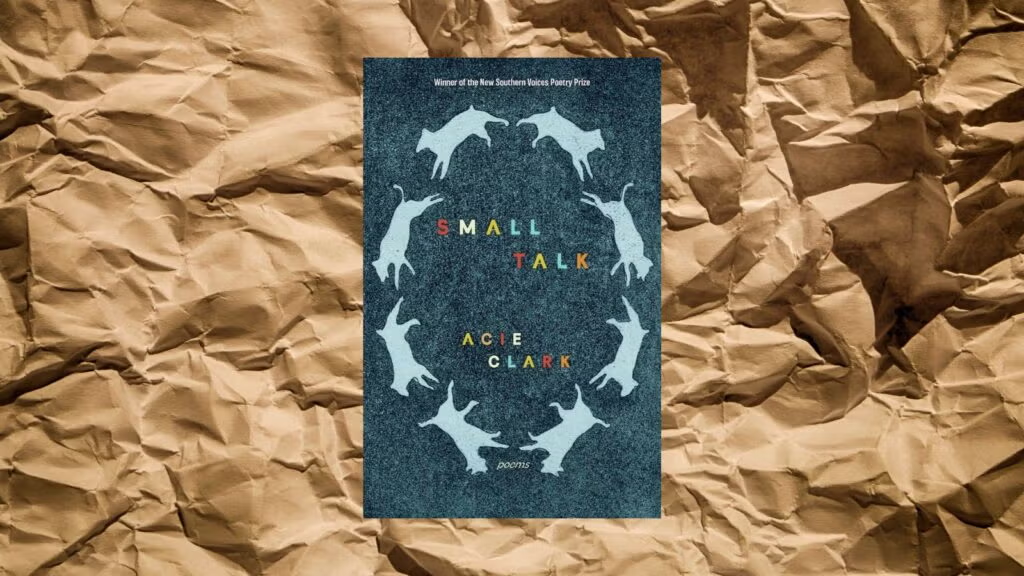
ALH: I want to talk about the book design, which is perfect. It’s a circle of light blue dog silhouettes on a dark blue background, and the title is in the middle in multicolored letters. I just feel like it fits the book so well.
AC: It was so special. I feel super grateful to the team at Hub City. They emailed me pretty early on in the process with a whole questionnaire that asked me questions about, like, how I wrote the book and any thoughts I had with regards to the cover. They asked me to send them some covers I liked, some covers I didn’t really like, and some covers of books that felt similar to mine, even if I didn’t want to go for that particular cover design. And then they asked me to send any words or associations or thoughts. And I think the only thing I sent them was “dogs.”
Then they sent me three images, and this was one of the images. It’s a copper etching—so a copper plate that you score and then carve into—by Adam Benedict called “Dog Dreaming.” I’d seen Adam’s work before, but I hadn’t seen this piece. I was sort of terrified when they sent it to me, because we didn’t know yet if we could use it. I am so glad Adam said yes, because if the answer had been no, I think I would have been heartbroken.
I wanted it to kind of be a little bit playful, because I know despite the funny parts, the book can be pretty heavy. It’s thinking about some tricky and complex things, and so I wanted the cover to have a bit of whimsy to it.
ALH: The book can be quite heavy. You’re writing about trauma and abuse. Some of these moments are conversations with the self, like we’ve talked about, but there are also conversations with real people in your life, about which you write pretty directly. How is addressing difficult things on the page a sort of conversation? And what does it mean to get real with someone in art?
AC: There’s an essay I really love by T Kira Madden called “Against Catharsis” where she says, “The Story is not The Life.” A first draft is so deeply and profoundly not the last draft—and yes, of course, maybe the first draft of the poem is an act of processing something in real time, but by the time the poem is something I’m thinking about artistically and asking other people to live in with me, it feels pertinent that I’ve made intentional choices about what I want to articulate and, critically, what I don’t.
One of the last poems in the book is, even if it doesn’t necessarily address my grandfather, it is addressing the question of my grandfather. I worked on this poem for years and I asked different things of it at different times. Ultimately, this is the version of the poem that I wanted to exist in the world, but I am interested in how I will continue to write about him and how I may renegotiate my stance across time.
I’m prepared to continue to change my mind. I think that so much of forgiveness is conditional. You may forgive someone because they have said something is never going to happen again, but then if it happens again, and suddenly that forgiveness is undone. I’m curious about the ways in which I can stand by everything I’ve said in this book, while also continuing to change how I feel and think about the events I’ve discussed here.
So, if this book taught me anything, it was that. From beginning to the end of the journey, there were so many different transformations, so many different periods of, like, you know, liquefying and coming out different.
And, you know, more…more life has happened since this book. I’ll be thinking about those things too, and those things are gonna constellate with previous things, and so… yeah, I’m interested in the fact that, like, we’re always… telling ourselves the stories of our lives, and I want to be intentional and careful about what that story is, while also being, ideally, honest with myself and the people in my life about how I’m understanding what’s happened.
But I think that conversation is obviously ongoing.
ALH: We’ve spent a lot of this interview talking about all the ways in which writing is an act of surprising oneself. What’s one specific thing that surprised you when you were writing and revising Small Talk?
AC: I think I wasn’t prepared for how different the process of revising a book is from revising individual poems. A poem may be done as an individual poem, but the poem actually has different work to do in the collection. So many of the poems started as sonnets; very few of them ended as sonnets. There were poems I had to cut. There were poems that I just didn’t think made sense anymore. There are other poems that are kind of, you know, I think of as B-sides.
I understood that logically, I had read other writers explaining this, but it really changed how I approached revision in the final stages of the book. I just could not have known how the change would feel until it happened.