

Welcome to Global Feminisms at the University of Michigan
The Global Feminisms Project archives oral history interviews with individuals who identify themselves as working on behalf of issues related to women and gender in different national contexts. While the selection of interviewees is made by local organizers at each global site, the project as a whole emphasizes the multiple forms of feminism present within and across these sites. The interviews are conducted by different individuals using a common base protocol developed by the collaborators from the first four country sites (China, India, Poland and the U.S.A.).
Our goal is to make these interviews as widely available as possible. We hope to encourage teachers and researchers to study issues related to the many forms of feminist or women’s movement activism in general, as well as activism on behalf of particular issues. Interviewees describe their lives, their views, and their activist efforts in considerable detail, and of course each one is unique. We offer the unedited interviews as primary sources for understanding the history of activism in all its complexity and variation. In addition to documenting the remarkable accomplishments and diverse experiences of project participants, the unedited interviews also include the expression of views, values, and priorities that at times conflict with positions held by other feminists within and beyond the Global Feminisms Project.
We provide annotations to the transcriptions of interviews that are aimed mainly at offering clarification of references that may be unfamiliar or unclear to many readers, but sometimes also provide leads to further information about a topic discussed. In addition, we provide maps, statistics, a timeline, podcasts about each site, and other resources to assist instructors and researchers in understanding the context in which the activists carried out their work. Finally, we provide specific resources for instructors; these include both podcasts about experiences teaching with the archive (with tips from those who’ve done it), and lesson plans designed around the interview material and sometimes drawing on contextual resources.
Watch the Zoom recording of the February 10, 2023 Global Feminisms webinar “Stories of Long COVID Advocacy in the United States”, here! (Transcript)
What’s New at Global Feminisms
The Global Feminisms Project is hiring Research Assistants for the 2026 to 2027 school year! Read more here!
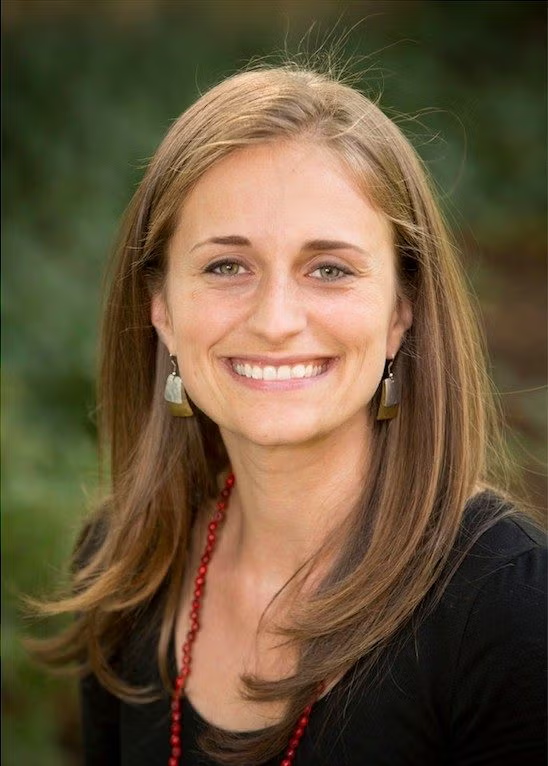
Abigail Dumes Receives 2026 Individual Award for Outstanding Contributions to Undergraduate Education!
The GFP Team is excited to announce that Abigail Dumes, co-director of The Global Feminisms Project, as well as Associate Professor of Women’s and Gender Studies, was awarded the 2026 Individual Award for Outstanding Contributions to Undergraduate Education by the College of Literature, Science, and the Arts!
This award recognizes faculty members who are exceptionally dedicated to the educational experiences of undergraduate students, and who demonstrate their dedication through achievements and innovations in their own and others’ classrooms and programs.
In her nomination materials, Professor Dumes is commended for her “record of innovative teaching excellence” and is described as an engaging, knowledgeable, and exemplary educator “whose teaching practices are ‘marked by excitement, empathy, and curiosity that foster strong rapport among students.’”
Read more about the award by clicking this link.
Congratulations, Professor Dumes! We are so proud of you, and thankful for everything you contribute to The Global Feminisms Project!
See how Professor Dumes teaches with the GFP archive here!
GFP Celebrates Two Decades of Collaborative Engagement, 2002-2025
GFP welcomed friends and colleagues from far and wide to celebrate over two decades of collaborative engagement with the Global Feminisms Project! The occasion was marked with a conference held in Ann Arbor that reflected on the project’s history, expansion, and future. Attendees joined us in panel discussions that reflected on the project’s beginnings, building the country sites, intersectional approaches to research, teaching with the archive, student staff experiences, and envisioning a future for GFP.
In addition to these panels, several undergraduate and graduate students were awarded the opportunity to develop and present creative research projects incorporating the archive’s materials. Research topics ranged from the caste system in the Indian subcontinent to feminist revolutionaries from Nicaragua, and students who were present at the celebration participated in brief interviews about their posters, which are accessible here: Celebrating Global Feminisms – Student Poster Presentations.
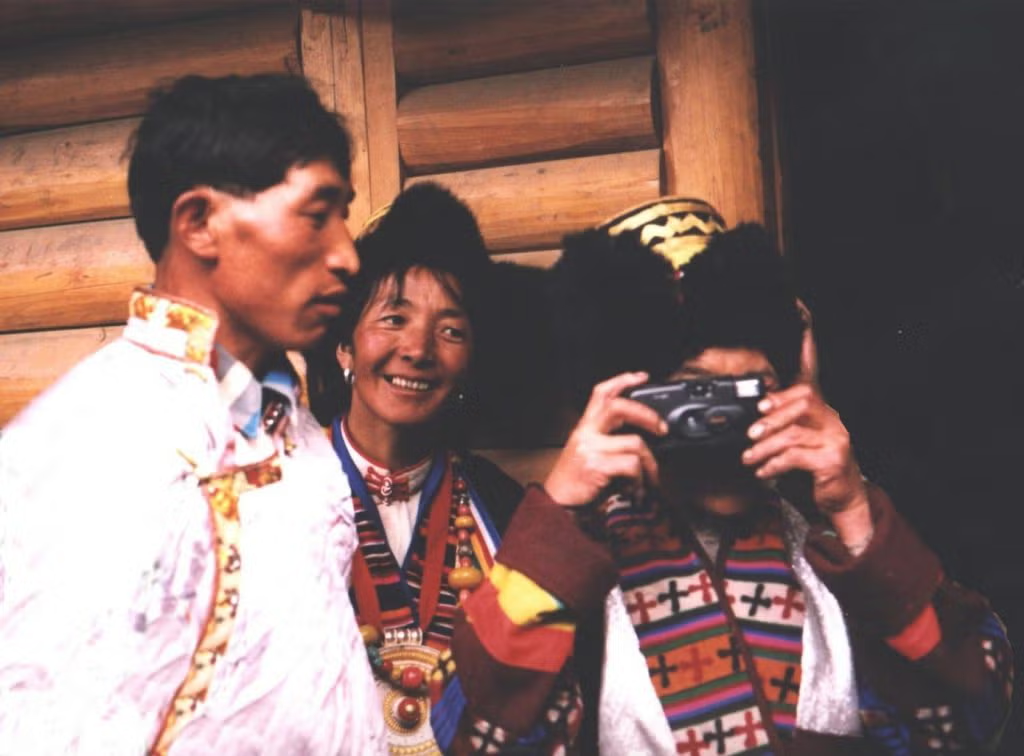
Contextualizing Feminist Voices Podcast
Our podcast series, Contextualizing Feminist Voices, was recorded in 2021 to provide additional information on the project’s materials. Each episode is brief (less than 10 minutes), with a project collaborator interviewing an expert who can provide context for the other materials and interviews.
Our second installment of the series, Teaching with the Global Feminisms Project, focuses on how individual teachers have used GFP materials in their courses.
Lesson Plans
Instructors are encouraged to use our topical lesson plans to teach about the diversity of women’s experiences and feminisms. The lesson plans are organized by key terms; instructors may also use the website’s search function to find lesson plans that include the key concepts, methods, or country sites they want to teach.
These lesson plans were developed with a generous project grant from the University of Michigan Humanities Collaboratory.
Global Feminisms News
The GFP team notes with sadness German interviewee Sigrid Metz-Goeckel’s death on February 11, 2025. A celebration of her life will be held on April 4, 2025. Details here: https://doo.net/veranstaltung/182905/buchung
On November 16th, 2024, four GFP associates spoke on the presidential panel about transnational feminisms at the annual National Women’s Studies Association Conference (NWSA), held in Detroit. The GFP panelists featured — Tamara Dávila (Nicaraguan interviewee), Seda Saluk (co-liaison for the Turkey site), Wang Zheng (liaison for the China site), and Sueann Caulfield (liaison for the Brazil site and GFP co-director) — discussed the work of the archive in the context of feminist movements they have participated in and/or researched.
From left to right: Nada Elia (panelist; Western Washington University), Heidi R. Lewis (NWSA President), Sueann Caulfield, Seda Saluk, Jessica N. Pabón (Panel Chair), and Wang Zheng. (Not pictured: Tamara Dávila.) Photo courtesy of Tafari Stevenson-Howard.

On November 13th, 2024, GFP co-sponsored a roundtable event with the Donia Center for Human Rights, the Department of Women’s and Gender Studies, and the Centers for Middle East, North African, and South Asian Studies. Entitled “Reproductive Rights as Human Rights: International Perspectives,” the discussion featured, amongst others, GFP collaborators Seda Saluk and Tamara Dávila.
From left to right, moderator Michele Heisler and panelists Tamara Dávila, Seda Saluk, and Payal Shah (on Zoom) discuss reproductive rights through international perspectives at the Donia Human Rights Center’s November event. Photo courtesy of Daryl Marshke, Michigan Photography, UM.

After 20 months of imprisonment under isolation and receiving a sentence of 9 years in prison on the charge of “aggression against the national sovereignty”, Dora María Téllez was banished and expatriated to the United States by the government of Nicaragua. She has been illegally stripped to their Nicaraguan nationality and has received a temporary humanitarian parole status to remain in the United States. Her struggle for democracy, social justice and defense of human rights has been internationally recognized and, while in prison, Téllez was awarded the 2022 René Cassin Prize in Human Rights by the Government of the Basque Country, Spain. For her exceptional political and scientific career as historian, she has also received two honorary doctorates from the University of Helsinki (2011) and from the Sorbonne-Nouvelle University (2022).
Congratulations to United States GFP interviewee Loretta Ross on being named a 2022 MacArthur Fellow!
Read #Womanifesto: What Nigerian Women Want, an important document in Nigerian women’s movement efforts, here. GFP partnered with CEW+ to host interviewee and #Womanifesto collaborator Abiola Akiyode-Afolabi on campus in the Fall of 2022.
On June 13, 2021, GFP interviewee Dora María Téllez was detained by the police in Nicaragua; on February 3, 2022, she was sentenced to 15 years in prison on the charge of “aggression against the national sovereignty” and barred from holding any public office in the future. Read the La Prensa article about the arrest (English translation) and Mónica Baltodano’s biographical piece about Téllez (English translation).
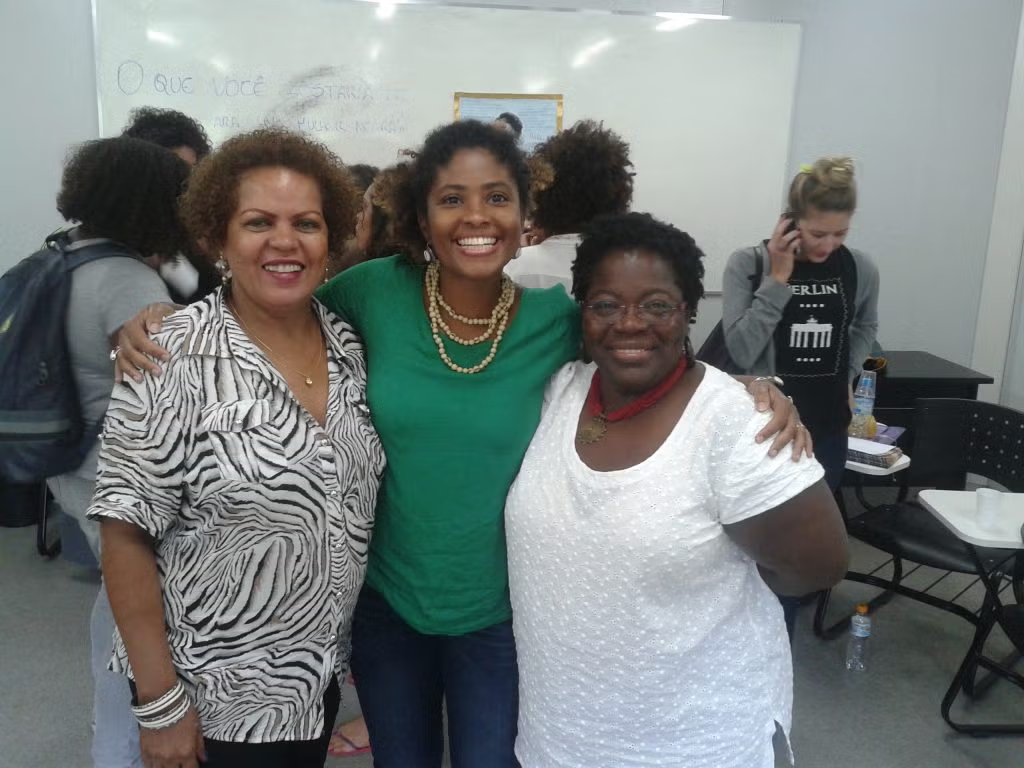
In June 2022 Sueann Caulfield, Claudielle Pavão, and Renata Saavedra worked alongside GFP interviewees Laura Castro and Marilda de Souza Francisco to organize the “Global Feminisms Seminar” in Brazil. The conference focused on the uses of the archive in teaching as well as reflections on oral history and feminist activism.
Listen to Andreea Coscai’s Who Holds Up Half the Sky – Podcast on Chinese Feminism, which focuses on critical issues from censorship of Chinese feminists to the broader meaning of feminism and transnational solidarity. In this podcast, Andreea, a 2022 Bennington College graduate, also interviews GFP staff members Özge Savaş and Wang Zheng.

