1942.11.27 “There’s Your Answer, Adolph.” by Wallace Heard Goldsmith

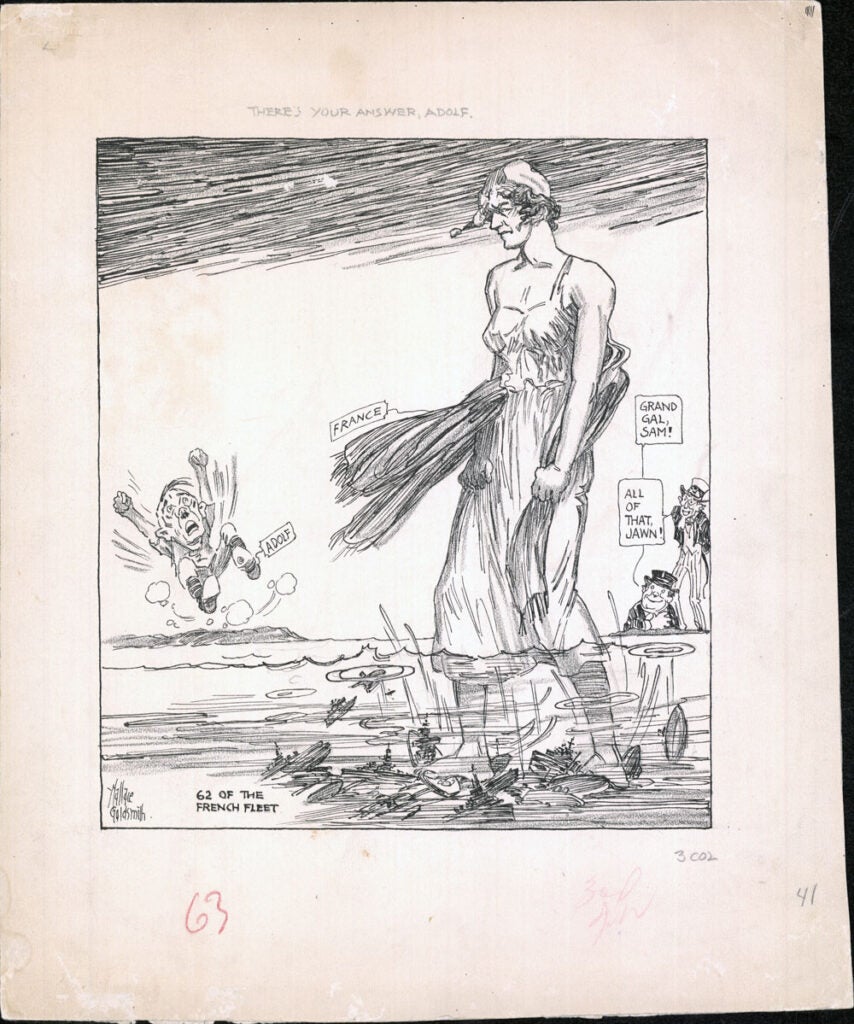
1942.11.27 “There’s Your Answer, Adolph.”
by Wallace Heard Goldsmith (1873-1945)
13 x 15.5 in, ink on board
Coppola Collection

https://en.wikisource.org/wiki/Author_talk:Wallace_Heard_Goldsmith

Goldsmith was a Boston institution, working over his long career at the Herald, the Post, and the Globe. This editorial cartoon is from his 25-year period at the Post.

At the turn of the century, the Boston Herald just couldn’t make up its mind whether it wanted to run a syndicate. Their homegrown comic section was born and died at least four different times. The Adventures of Little Allright came in the third version of their Sunday section and ran from March 6 to June 26 1904. There really wasn’t much to set the strip apart from any other kid strip — the starring kid saying “all right” a lot seems an almost ridiculously weak hook. Goldsmith took the dubious credit for this stinker. The strip was rebooted as Little Alright (the second ‘L’ was dropped), and ran from November 11 1906 to April 14 1907. He was well known for illustrating Oscar Wilde’s “The Canterville Ghost.”

After the Fall of France and the Armistice of 1940, France was divided in two zones, one occupied by the Germans, and the “Free Zone”. Officially, both zones were administered by the Vichy regime. The armistice stipulated that the French fleet would be largely disarmed and confined to its harbors, under French control. The Allies were concerned that the fleet, which included some of the most advanced warships of the time, might fall into enemy hands and so the British attacked the French Fleet at Mers-el-Kebir on July 3, 1940, and at the Battle of Dakar on September 23, 1940.

On November 8. 1942 the Allies invaded French North Africa. It is thought that General Dwight Eisenhower, with the support of FDR and Winston Churchill, made a secret agreement with Admiral François Darlan, commander of Vichy Naval forces, that Darlan would be given control of French North Africa if he joined the Allied side.

Hitler responded to the invasion by sending in his forces, with the intent of capturing the French fleet and turning it over to Italy. As the German and Italian troops closed in on the port of Toulon, a plan was already in place: turn them back; and if that did not work, scuttle the fleet.

The French played along, looking like it was strengthening its defenses against the Allies. On November 12, Darlan called for a declaration of defection.

German combat troops entered Toulon early on November 27. By about 5 AM, German tanks rolled through, and the lead French ship immediately transmitted the order “Scuttle! Scuttle! Scuttle!” by radio, visual signals and dispatch boat. French crews evacuated, and scuttling parties started preparing demolition charges and opening sea valves on the ships.

In the final accounting, 77 vessels were scuttled. Another 39 were damaged and disarmed. Some of the major ships were ablaze for several days, and oil polluted the harbor so badly that it would not be possible to swim there for two years.
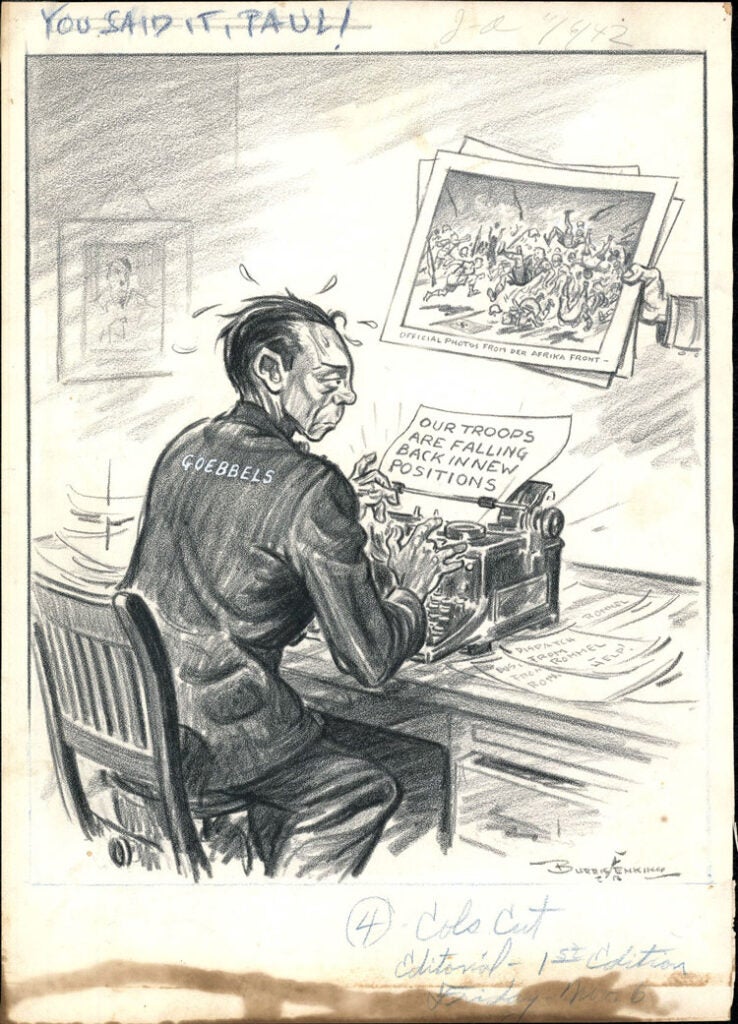
1942.11.06 “You Said It, Paul” by Burris A. Jenkins, Jr.

1942.11.06 “You Said It, Paul”
by Burris A. Jenkins, Jr. (1897-1966)
10 x 16 in, ink and crayon on board
Coppola Collection

http://www.original-political-cartoon.com/cartoon-gallery/artists/jenkins-jr-burris-1897-1966/

Burris Jenkins Jr. was the son of a prominent Kansas City minister, war correspondent and newspaper editor. Jenkins Jr. was a popular sports cartoonist, whose work appeared in the New York Journal-American from 1931. His humorous published verses were also popular. Although best known for his sports themes, Jenkins was also a skilled courtroom illustrator and editorial cartoonist.

Jenkins was not afraid to provoke, and he has some strong WW2 examples, including one of the rare direct commentaries on concentration (death) camps. Among his best-remembered cartoons are his angry piece on the discovery of the dead Lindbergh baby, and his sentimental image of Babe Ruth’s farewell to Yankee Stadium.

He was fired from his first job at the Kansas City Post for a series of pessimistic Christmas cartoons, a firing that prompted his father’s resignation from the same newspaper.

His father was an interesting guy. Jenkins, Sr (1968-1945) was ordained in 1891 and served as a pastor in Indianapolis. He received advanced degrees from Harvard and went on to serve as a professor and president of the University of Indianapolis and president of Kentucky University. He left Kentucky to return to Kansas City as pastor of the Linwood Boulevard Christian Church. The church burned in 1939, and Jenkins chose Frank Lloyd Wright as the architect for the church’s new home overlooking the Country Club Plaza.

Jenkins served as editor of the Kansas City Post from 1919 to 1921, hoping to fight for the establishment of the League of Nations. The Jenkins, Sr., biography tells the story about his leaving the Post slightly differently that for the son: “After two years, it became necessary for him to choose between the newspaper and his pulpit and, without hesitation, he resigned from the Post.”

“Live dangerously!” Jenkins would thunder from the pulpit, embracing his own philosophy against all adversaries. Unconventional in nearly every aspect of his chosen field, Jenkins often preached from non-Biblical texts, such as the latest book or his travels abroad. The church frequently hosted motion pictures, dances, card games, and fundraising boxing matches. These activities led to opposition to Jenkins and his Community Church from other churches in the city.

This cartoon is from November 7, 1942. Paul Joseph Goebbels was the Reich Minister of Propaganda under Hitler, and it is remarkably prescient. After a lengthy period of build-up and training, the Eighth Army launched a major offensive, decisively defeating the Italian-German army during the Second Battle of El Alamein (October 23 – November 11, 1942), driving the Axis forces westward and capturing Tripoli in mid-January 1943.

On and around November 1, the Germans had begun retreating from their positions and were on the defensive, and this is likely what is being referenced here. And the situation on the African front was about to get much worse for the Wehrmacht.

On November 8-16, the US and the UK conducted Operation Torch, a three-pronged attack to re-take northern Africa. As any fan of classic movies knows, the region was dominated by the Vichy French, officially in collaboration with Germany, but with mixed loyalties, and reports indicated that they might support the Allied initiative.

Operation Torch was one of the first large-scale engagements using US troops in the Europe/Africa battle.

The Eastern Task Force met the least opposition because the French Resistance had staged a coup in Algiers, and the Allies were able to push inland and compel surrender on the first day. The Center Task Force suffered some damage to its fleet, trying to land in shallow water, but the enemy ships were sunk or driven off, and Oran surrendered after heavy fire from British battleships. The Western Task Force, led by General Patton, encountered unexpected resistance, as well as bad weather, but Casablanca (see, told you so), the principal French Atlantic naval base, was captured after a short siege.

Although an initial release date was anticipated for early 1943, the film Casablanca premiered at the Hollywood Theater in New York City on November 26, 1942, to coincide with the Allied invasion of North Africa and the capture of Casablanca.

Set in late 1941, but prior to Pearl Harbor, Casablanca features the officially neutral (like the US) Rick (Humphrey Bogart) running an upscale club, frequented by Vichy French and German officers. Rick had escaped during the Nazi occupation of Paris (June 1940), soon after he had met and fell in love with Ilsa (Lauren Bacall), who just before they are to run off together discovers that her late husband, Victor Lazlo (Paul Henreid), a famous leader and fugitive of the Czech resistance, is still alive after escaping from a concentration camp. She abandons Rick to care for Victor. A year later, not knowing that Rick has ended up there, Victor and Ilsa turn up in Casablanca to attempt an escape to America. Sparks fly, intrigue follows… and here’s looking at you, kid.

1942.10.05 “The Most Unkindest Cut of All” by Charles (Chuck) Werner

1942.10.05 “The Most Unkindest Cut of All”
by Charles (Chuck) Werner (1909-1997)
18 x 18 in., ink on paper
Coppola Collection

Charles (Chuck) Werner was born in Marshfield, Wisconsin in 1909. Werner began working as a political cartoonist for the Indianapolis Star in the late 1940s. Werner was a Pulitzer Prize winner and worked as a cartoonist with several newspapers such as the Chicago Sun and the Daily Oklahoman before moving to Indianapolis. Charles Werner died in Indianapolis in 1997.

Werner won the Pulitzer Prize for Editorial Cartooning in 1939 for a cartoon he did for the Daily Oklahoman titled “Nomination for 1938” which Agreement which allowed for the transfer of the Sudetenland to Hitler’s Germany. At age 29, Werner was the youngest person to win the Pulitzer Werner left the Daily Oklahoman to be the Chief Editorial Cartoonist at the Chicago Sun in 1941 before leaving for the Indianapolis Star
Chi Award for excellence in journalism in 1943 and seven Freedom Foundation Awards from 1951 to 1963. At the 1969 International Salon cartoonists. In 1959 and 1960, Werner served as the president of the Association of American Editorial Cartoonists.

Throughout his nearly sixty year career, many U.S. Presidents expressed interest in Werner’s cartoons. In 1965, Lyndon B. Johnson requested President Harry Truman also requested a cartoon for his presidential library.

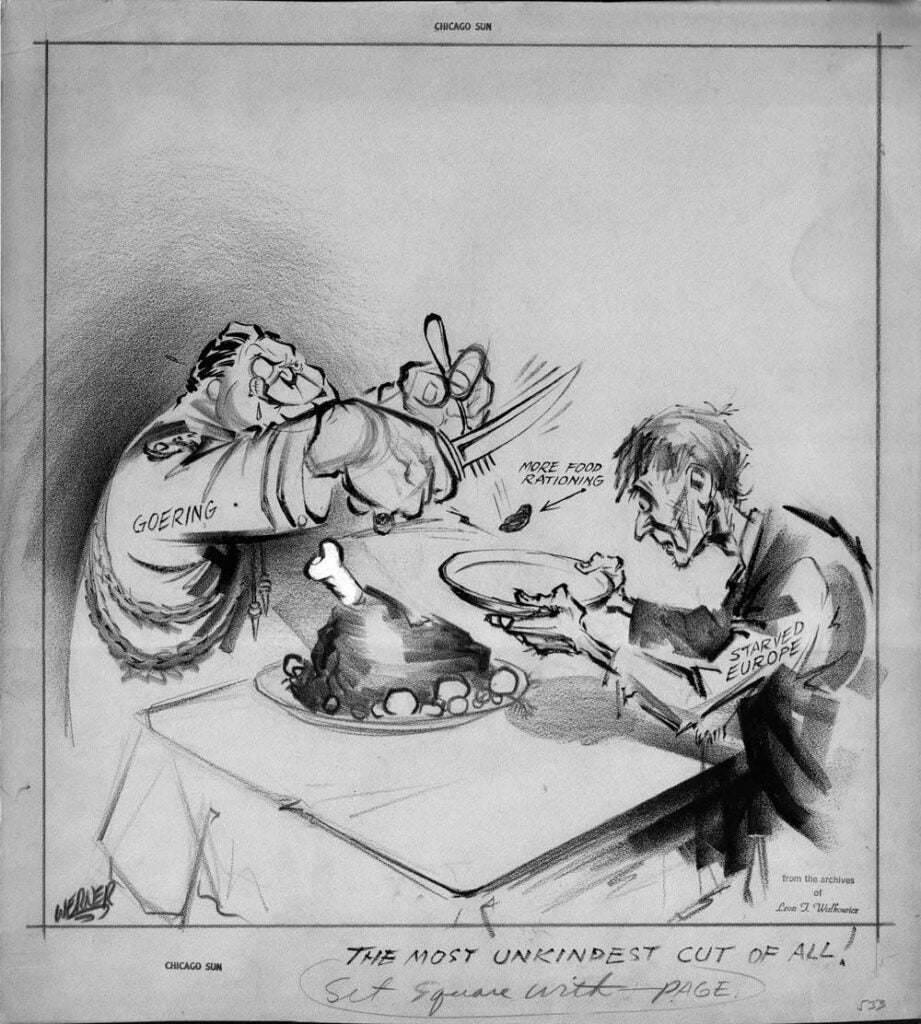
Early in the planning for war, Hitler put Goering in charge of the Four Year Plan. The purpose of the Four Year Plan was to provide for the rearmament of Germany, and to prepare the country for self-sufficiency in four years, from 1936–1940, including both industry and agriculture. Stockpiling food was a high priority, as WWI had demonstrated the effects of supplies when carrying out these large military campaigns.

Adolf Hitler had imposed price controls on the German people in 1936 so that his government could buy war materials at artificially low prices. Later, in 1939, Goering imposed rationing. Roosevelt and Churchill also imposed price controls and rationing, as governments tend to do during all-out wars.

And although the Four Year Plan technically expired in 1940, the “Office of the Four Year Plan”, a cabinet-level agency, had grown to such a power-base that the plan was extended indefinitely.

With the military setbacks in 1941, particularly with the Soviets, and two bad grain harvests in 1940 and 1941, the stores were drained by the end of the year. By mid-1941 the German minority in Poland received 2,613 calories per day, while Poles received 699 calories, and Jews in the ghetto 184 calories. Starvation became a modus operandi in the Nazi playbook throughout the rest of the war.

By April 1942, food needed to be moved from east to west, towards Berlin, reducing the amount available throughout Europe to feed the war effort. And at this point, the high command made the insidious conclusion that increasing the campaign of genocide would only help to increase the food supplies for Berlin.

In early October 4, 1942, Goering gave a broadcast address at the Harvest Thanksgiving festival, news of which was carried around the globe.

These problems have been solved and will never recur. The conquered territories are the most fertile in Europe. Most of the talk about the seriousness of the food situation in occupied countries is just propaganda. I am firmly resolved that while I do not want to see the populations of occupied countries suffer hunger and privation, if through enemy measures privation is unavoidable it will in no circumstances affect Germany.

German workers and German agricultural laborers will be fed better than any others. The German peasant goes out to fight, leaving his work to women. Children are helping as soon as they are able.

There should be no difficulty feeding Germany, but there are over six million foreign workers in Germany and over five million prisoners of war who have to be supplied.

Now that the future is clearer, the meat ration is to be increased by another fifty grams in the raid-threatened areas.

The German people come before all other peoples for food.

The whole German Army is fed from conquered countries.

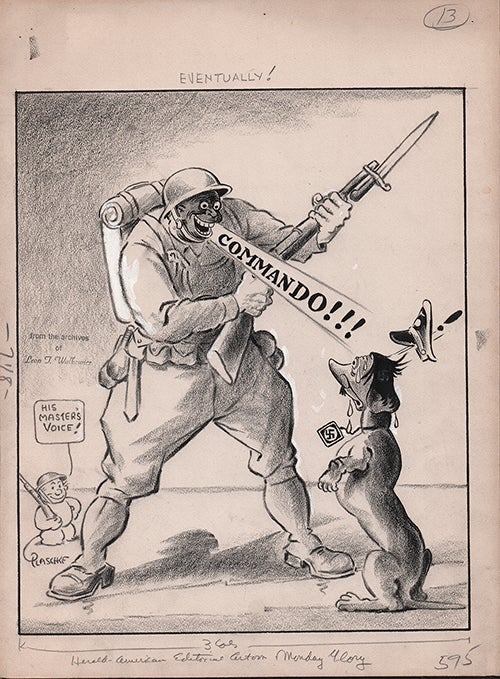
1942.09.22 “Eventually” by Paul Albert Plaschke

1942.09.22 “Eventually”
by Paul Albert Plaschke (1880 – 1954)
24 x 36 in., ink and charcoal on paper

Coppola Collection

Going by the date printed on the back of this drawing, the editorial cartoon here is potentially poignant, from a historical perspective.

The British Commandos were formed in 1940 as a raiding force for Occupied Europe. By 1942, they were racking up successes, so the cartoon is probably an enthusiastic response to these. The 2022 BBC series, SAS: Rouge Heroes, is about this group.

In documents captured by the Germans, Hilter was enraged to learn that there were instructions to “bind prisoners,” and German Intelligence reports cited Commando raids where prisoners who were captured and later found dead and bound.

Together, these raids are believed to have motivated Hitler, on October 18, to issue the Commando Order (Kommandobefehl). The order, which was executed in only 12 copies and in secret, stipulated that any Allied commandos encountered by German forces in Europe and Africa should be killed immediately without trial, even if they attempted to surrender. The order also made it clear that failure to carry out these orders by any commander or officer would be considered to be an act of negligence punishable under German military law. Hitler invoked violations of the Geneva Conventions due to the alleged killing of bound German prisoners by the Allies.

The notion of a “Commando Order” to Hitler, as shown here, is a macabre irony.

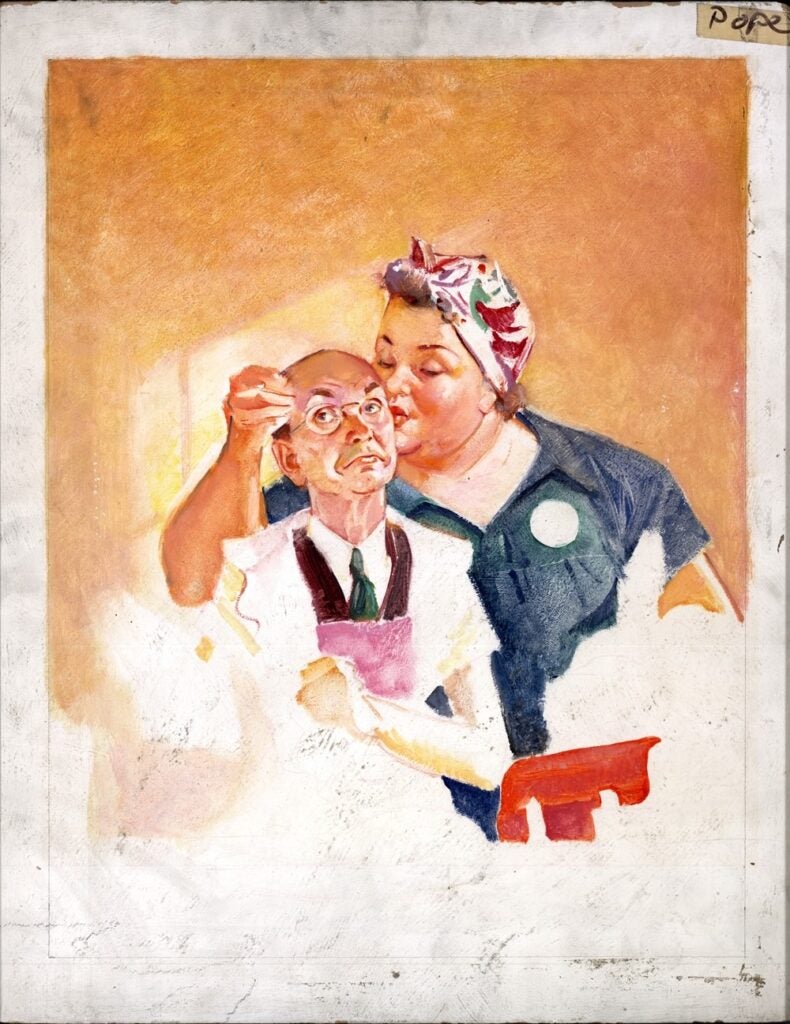
1942.09.01 “See You For Dinner” (artist unknown)

1942.09.01 “See You For Dinner”
artist unknown
18 x 27 in., acrylic on board
Coppola Collection

There is just no telling where and for what purpose this partially completed painting was made.

With men off to fight a worldwide war across the Atlantic and the Pacific, women were called to take their place on the production line. The War Manpower Commission (April 1942), a Federal Agency established to increase the manufacture of war materials, had the task of recruiting women into employment vital to the war effort.

The painting features a woman with many of the features of the iconic “Rosie the Riviter,” a painting by Norman Rockwell, published as the cover to The Saturday Evening Post on May 20, 1943 (see additional).

The other stuff I bought with this is all WW2 era editorial cartoon art.

The intent is clear: a delightful “other side of the story” on Rosie’s life. Her strength is being applied every day to the war effort while Mr Riviter is at home, tending to the chores.

For the record, you might have encountered the “We Can Do It!” image as Rosie, but that came 40 years later.

The “We Can Do It!” image is from an in-house 1942 work campaign at Westinghouse, meant to inspire workers to work harder. I was not a public image and was on display for two weeks (see additional).

The origins of “Rosie the Riviter” and the associated representation for the women who famously joined the workforce during WW2 also date to popular 1942 song of the same name. Depictions of women in coveralls with short sleeves and their hair in bandanas were commonly represented on the sheet music for the song. It is possible that the Westinghouse poster was influenced by these images.

By the time Rockwell paints the Post cover, in mid-1943, the look for Rosie the Riviter had been established and people would have known at a glance what and who they were looking at.

The Rockwell painting was reproduced widely, and used during a War Bond campaign. After the war, the image faded from view.

In the 1980s, the “We Can Do It!” image was rediscovered and used in conjunction with a women’s empowerment message. At some point, the image became strongly attributed as the Rosie the Riviter, in part, it is speculated, because of the copyright issues surrounding reproduction of the Rockwell painting.

At any rate, the “We Can Do It!” image has been widely used over the last 40 years and is often labeled as Rosie, including its availability on souvenir items – from shirts to shot glasses – that you can buy from the museum shop at the National WW2 Museum in New Orleans (which is an awesome museum, by the way).

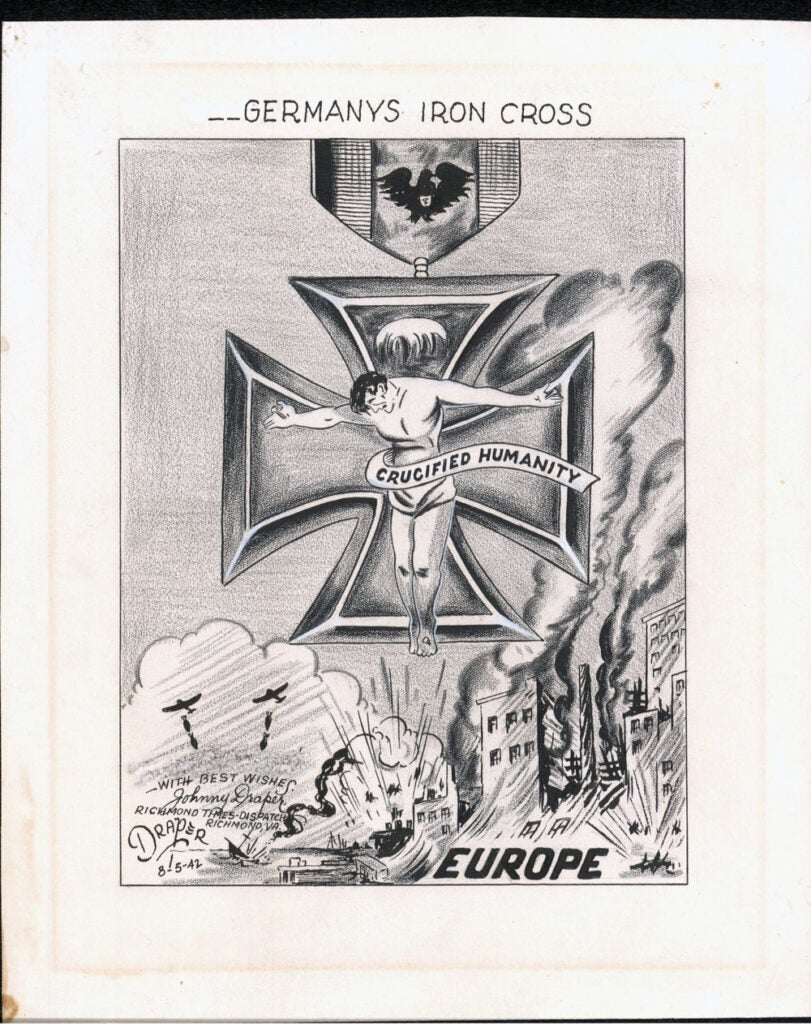
1942.08.05 “Germany’s Iron Cross” by Johnny Draper

1942.08.05 “Germany’s Iron Cross”
by Johnny Draper
9 x 10 in., ink on board
Coppola Collection

I cannot find anything out about Johnny Draper beyond what you see here: he worked for the Richmond Times Dispatch in Richmond VA. The piece was in the hands of Murray A Harris for a long time (on reverse).  Harris was an illustrator and noted collector who died in 1997.

In 1942, the Nazi forces were on the move everywhere.

By July, Germany was making its first direct assault on British military defenses at El Alamein (Egypt). In the east, progress towards Stalingrad was slow and steady. To the southeast, the Russia army was in retreat in the Caucuses, opening up access to precious oil resources. And the systematic deportation of Jews from the Warsaw Ghetto began on July 22.

The Knight’s Cross of the Iron Cross and its variants were the highest awards in the military of the Third Reich during World War II. This military decoration was awarded for a wide range of reasons and across all ranks, from a senior commander for skilled leadership of his troops in battle to a low-ranking soldier for a single act of extreme gallantry. The Knight’s Cross of the Iron Cross with Oak Leaves was introduced on June 3, 1940 to further distinguish those who had already received the Knight’s Cross of the Iron Cross and who continued to show merit in combat bravery or military success. A total of 111 awards were made in 1942, with the mid-year recognitions going to pilots of the Luftwaffe.

This cartoon is about as self-explanatory as it gets.

1942.07.25 “Well Boys… It’s the End of the Line” by Harold Eugene “Gene” Luttenton

1942.07.25 “Well Boys… It’s the End of the Line”
by Harold Eugene “Gene” Luttenton (1911-1998)
17 x 18 in., ink on board
Coppola Collection

Luttenton attended the American Academy of Art in Chicago to become an editorial cartoonist and served in the U.S. Army, both in Europe and in the Pacific during WWII. Later in his life, Gene was a member of the Cape Coral American Legion Post #90, in Florida.

Eventually, the Axis lost its advantage, which derived, at least in part, from the disorganized and depressed world in which the alliance formed. By the middle of 1942, the Allies, joined by the Russians after Barbarossa (June 1941) and the US after Pearl Harbor (December 1941), we begin to see progress as the war starts to be fought on too many fronts.

1942.07.16 “War Comes to Town” by AB Chapin

1942.07.16 “War Comes to Town”
by AB Chapin (1875-1962)
18 x 18 in., ink on paper
Coppola Collection

Archibald B. Chapin was a renowned editorial cartoonist in the Midwest. He spent his early career in Kansas City, St Louis and Philadelphia. In 1942, he moved to Schenectady, New York, and drew a weekly cartoon for the National Weekly Newspaper Service. He died October 19, 1962, which means he was certainly staying active as an editorial cartoonist into his late 80s.

In early 1942, the US population needed to adjust to the civilian consequences of being in a large-scale war in ways that we have not faced since WWII.

By early 1942, Japan had overrun the SE Asian nations from which over 90% of our rubber was produced. The production of synthetic rubber had just begun and was nowhere near ready to fill the void. Rationing tires and rubber goods started in January 1942: you could keep five tires per automobile and needed to give up the rest. A national rubber drive to collect anything made with rubber was held in June, and most civilian products made from rubber were no longer manufactured. Even rubber for footwear (boots and shoes) started to be rationed on September of that year.

Metal was needed for the military effort, too. Automobiles and typewriters were not produced from 1942-45, and stores simply ran out of everything from paperclips to alarm clocks, razor blades to zippers. Replacing household items sold in tins, ranging from toothpaste to medicines, required the old container to be turned in to get a new one. Later in the war, this extended to canned food items.

In this cartoon, AB Chapin presents a slice of life montage. No explanations were needed because everyone was living it. The citizens needed the proper cards or their ration books to buy everyday items. There are references to “card parties” (people getting together to play cards, the entry fee going to benefit the war effort), the unpatriotic way in which someone might drive their car and put unnecessary wear on the tires, and the somewhat mysterious role that eighteen seventy-five would serve to “sock it to the Japs” (The $25 war bond was purchased for $18.75).