1944.06.17 “And it was such good reading” by Jack Lincoln Lambert

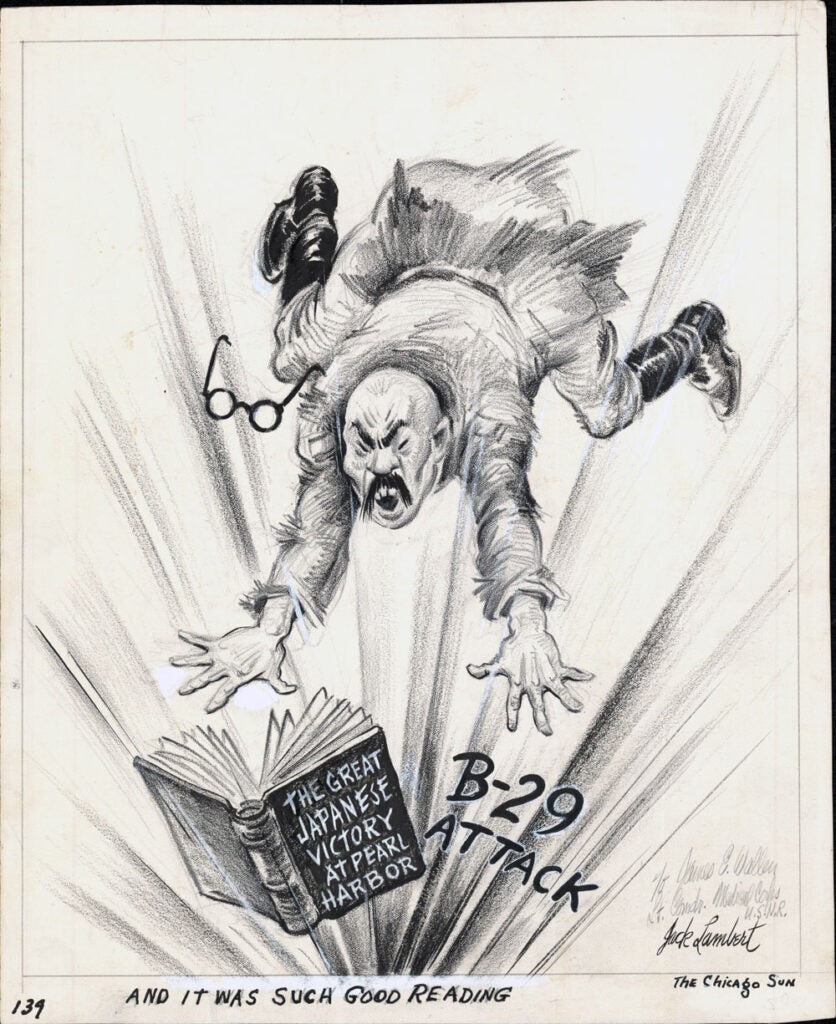
A caricature of a frightened man in military uniform, glasses falling off, tumbles toward an open book labeled The Great Japanese Victory at Pearl Harbor as B-29 Attack explodes from the pages. Text: AND IT WAS SUCH GOOD READING.

1944.06.17 “And it was such good reading”
by Jack Lincoln Lambert (1892-1967)
12 x 15.5 in, ink on board
Coppola Collection

https://prabook.com/web/jack_lincoln.lambert/1090838

Jack Lincoln Lambert was a sculptor and a cartoonist. He received four awards for newspaper cartooning and had served with Medical Corps, United States Army, 1917-1919. His editorial work was for the Baltimore Evening Sun (1938-42), the Chicago Sun (1942-48), the Baltimore News Post (1948-64), and then the New-American, Baltimore.

The Bombing of Yawata on the night of June 15, 1944 was the first air raid on the Japanese home islands conducted by the US Army Air Forces B-29 strategic bombers during World War II.

The raid was carried out by 75 of the Superfortress bombers that were staged from bases in China. Only 47 of the aircraft bombed the raid’s primary target, the Imperial Iron and Steel Works at Yawata, and little damage was caused.

While the raid did not achieve its aims, it had other effects. It raised Japanese civilians’ awareness that their country was being defeated and received unduly positive media coverage in the United States. Intelligence gathered by the B-29s also revealed weaknesses in Japan’s air defenses and the raid was the first of many on Japan.

According to the notation on the back, this was gifted to a fan on July 3.

1944.06.09 “Scuttle Her!” by C A Maggi

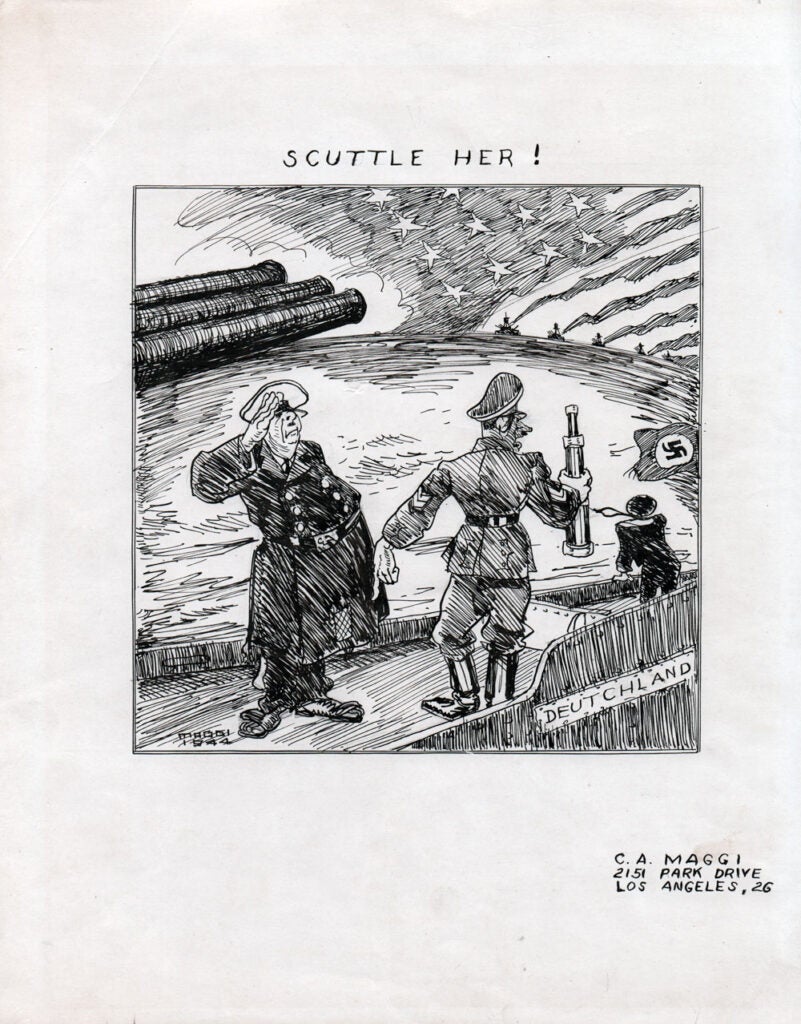
Black-and-white political cartoon shows two uniformed men labeled Deutschland by a battleship; one gestures toward the ship, the other holds a telescope. A sailor in the water swims toward a lifebuoy marked with a swastika.

1944.06.09 “Scuttle Her!”
By C A Maggi
12 x 14 in., ink on board
Coppola Collection

I have no information about this artist.

The United States Navy grew rapidly during World War II, playing a central role in the war against Japan. It also assisted the British Royal Navy in the naval war against Germany and Italy. The largest amphibious invasion of all time was the D-Day invasion of France in June 1944.

By the end of D-Day, 156,000 Allied soldiers had come ashore on the Normandy beaches with losses of 2,500 men. By the end of the day, the Allies had established a tenuous beachhead that would lead to an offensive that pinned Adolf Hitler’s Third Reich between two pincers–the Western Allies and the already advancing Soviets–accelerating the end of World War II.

A million Allied troops, under the overall command of General Dwight D. Eisenhower, moved onto five Normandy beachheads in three weeks.

Seeing the US navy coming over the horizon, Hitler begins to get the hint. As a routine practice, you scuttle your materiel rather than have it fall into the hands of the enemy, who can turn around and use it against you. Hitler would eventually, indeed, take down Germany with him.

1944.06.06 “The Pit and the Pendulum” by Gordon Smith

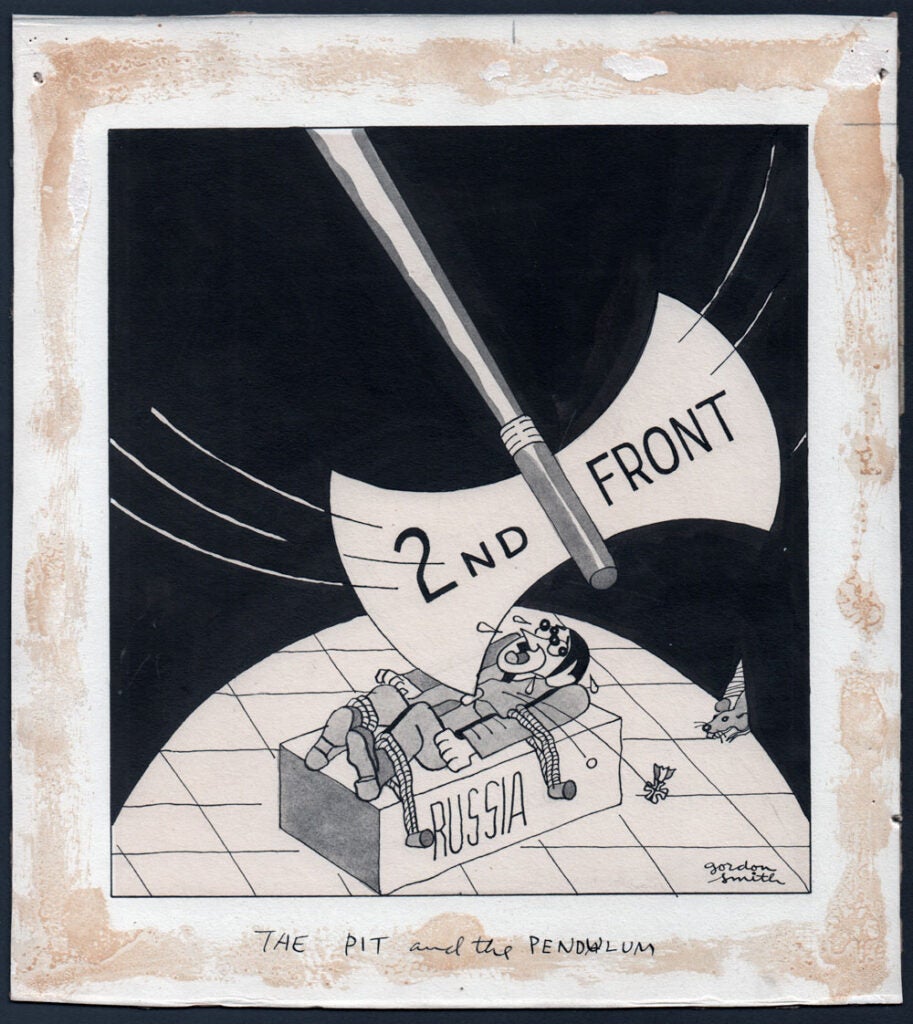
A cartoon shows Hitler, tied to a box labeled Russia, as a large swinging axe labeled 2nd Front swings toward him. Hitler looks worried, referencing the WWII opening of a second front against Nazi Germany.

1944.06.06 “The Pit and the Pendulum”
By Gordon Smith
11 x 14 in., ink on board
Coppola Collection

The D-Day landings in June 1944, created a second-front and took the pressure off the Red Army and from that date they made steady progress into territory held by Germany.

This cartoon is attributed to the Boston Post, but I cannot track the artist, yet. At least the signature is clear.

1944.02.28 “Still the Fulcrum” by William (Bill) Crawford

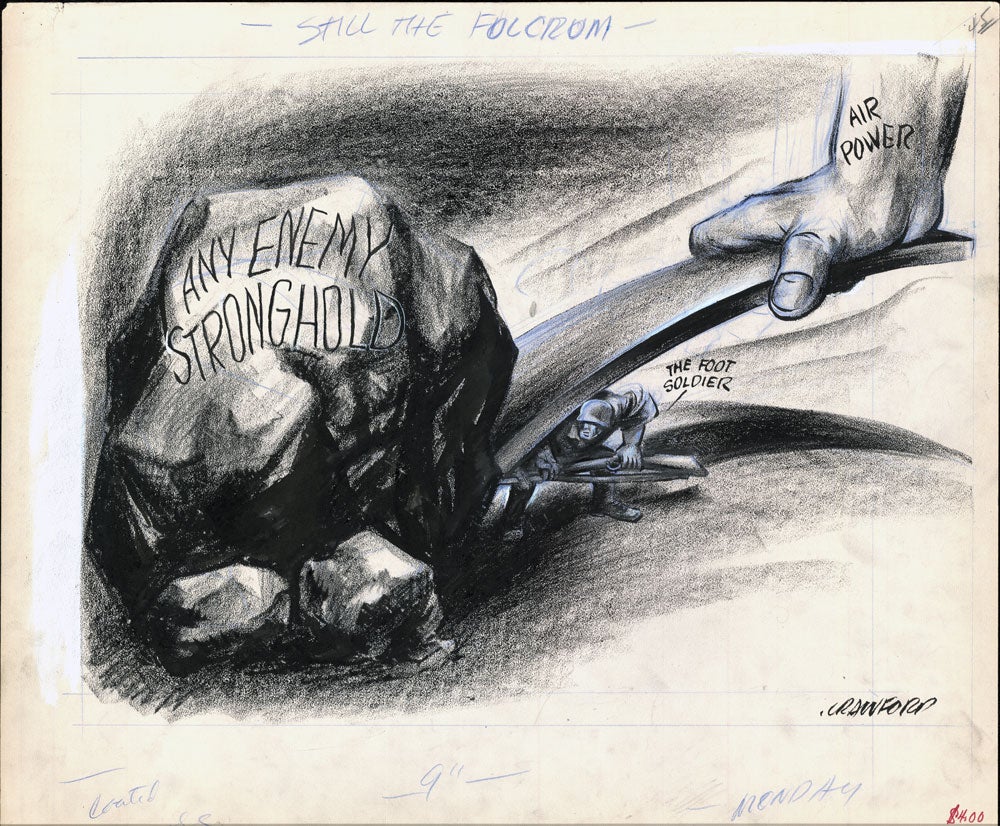
A drawing shows a large rock labeled Any Enemy Stronghold being levered by a pole labeled The Foot Soldier. A large hand labeled Air Power pushes down on the pole to help lift the rock.

1944.02.28 “Still the Fulcrum”
William (Bill) Crawford (1913-1982)
19 x 22 in., ink and crayon on heavy paper
Coppola Collection

https://en.wikipedia.org/wiki/Bill_Crawford_(cartoonist)

Crawford worked as a sports cartoonist and for the Washington Daily News and the Washington Post from 1936-38. He joined the Newark News as an editorial cartoonist and his cartoons were distributed to more than 700 daily newspapers by the Newspaper Enterprise Association. He was an active member of the National Cartoonists Society, serving as its president and vice-president. In 1956, 1957, 1958, and 1963 he was awarded “Best Editorial Cartoon” by the National Cartoonist Society, and in 1973 he received their Silver T-Square Award. Crawford retired in 1977.

“Strategic effectiveness on the modern battlefield in the twenty-first century is centered on the reality that airpower needs landpower to be strategically relevant. Landpower, by contrast, merely desires airpower because it makes both offensive and defensive maneuvers less risky by degrading and disrupting adversarial ground forces. There is a codependence between the two, but it is unequal. That fact is perhaps threatening to some advocates of airpower, but it need not be. Airpower’s decisiveness might be in question— domination in the air domain does not equal domination in the ground domain—but its relevance is unequivocally not.”

Jahara Matisek and Jon McPhilamy (Modern War Institute, November 5, 2018)

The Army’s major commands were given to infantrymen Douglas MacArthur and Dwight D. Eisenhower. Neither had paid much attention to aviation before the war. However, in July 1942, the air power advocate Jimmy Doolittle instituted a critical change in strategic fighter tactics and the 8th Air Force bomber raids faced less and less Luftwaffe defensive fighter opposition for the rest of the war.

MacArthur had been badly defeated in the Philippines in 1941–42 primarily because the Japanese controlled the sky. His planes were outnumbered and outclassed, his airfields shot up, his radar destroyed, his supply lines cut. His infantry never had a chance. MacArthur vowed never again.

In the highly visible “Big Week” campaign (February 20-25, 1944) American bombers flew 3,800 sorties, dropping 10,000 tons of high explosives on the main German aircraft and ball-bearing factories. Ball bearing production was unaffected, as Nazi munitions boss Albert Speer repaired the damage in a few weeks. Sensing the danger, however, Speer began dispersing production into numerous small, hidden factories.

The need for coordination between ground and air coverage was clear.

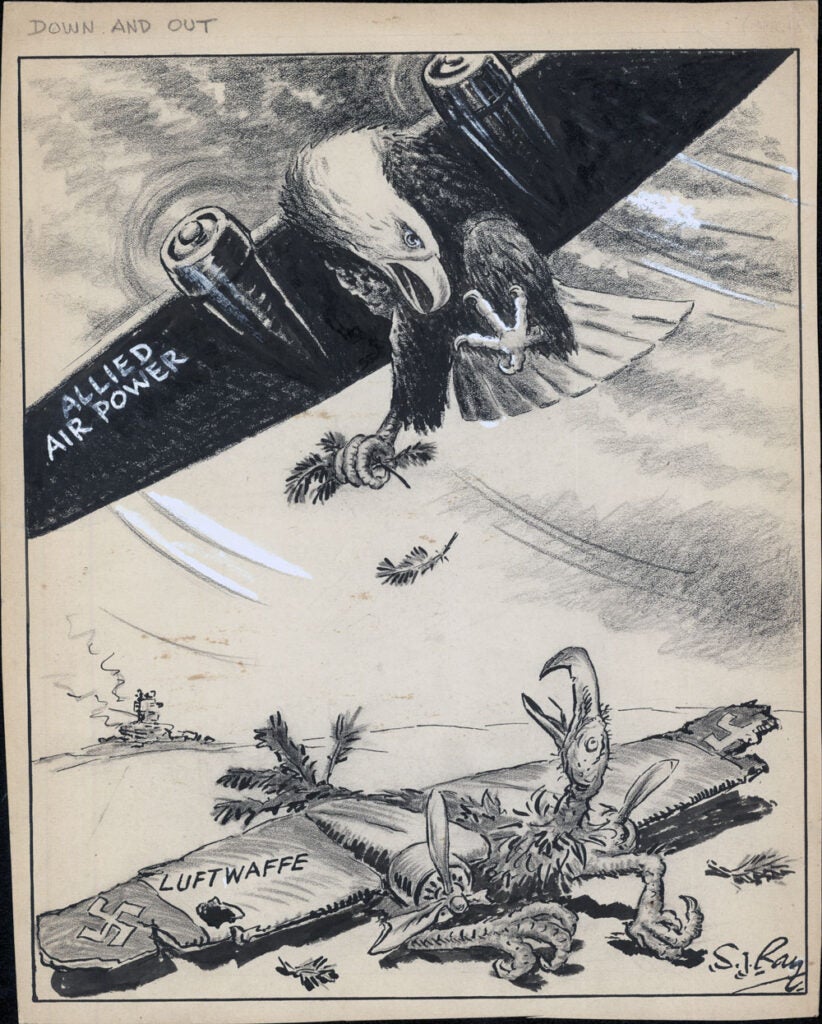
1944.02.25 “Down and Out” by Silvey Jackson (SJ) Ray

A cartoon eagle labeled “Allied Air Power” attacks and defeats a vulture labeled “Luftwaffe” above a crashed plane, symbolizing Allied victory over Germany in WWII. Smoke rises from wreckage in the background.

1944.02.25 “Down and Out”
by Silvey Jackson (SJ) Ray (1891-1970)
12 x 15 in., ink and white watercolor over graphite on pebble-grain Coquille board
Coppola Collection

https://kchistory.org/blog/history-cartoons-artwork-s-j-ray

S.J. Ray was a student at the Art Students League of New York and was a World War I veteran. He joined the Kansas City Star in 1915 as an advertising illustrator and became the Star’s editorial cartoonist in 1931. He served in that post until retirement in 1963, drawing an estimated 10,000 cartoons. He received honors from the U.S. Treasury Dept. for his cartoons during World War II in behalf of the National War Savings Program.

The Luftwaffe was a strength of the Wehrmacht.

On August 17, 1943, the US Air Force launched its deepest raid against the ball bearing factories at Schweinfurt and aircraft production factories at Regensburg. The bombs destroyed some of the factory complexes, but the Luftwaffe destroyed or damaged much of the bomber force.

After more raids, the Air Force made another massive effort to hit the Luftwaffe. On September 6, 262 bombers were sent against Stuttgart. Of those, 45 fell to fighters and flak. In October 1943, the US air losses became critical, forcing a reappraisal of the American daylight bombing Strategy.

The changes that paid off came from several sources.

Major General James H. “Jimmy” Doolittle took command of the US Air Force on January 6, 1944. Based on his extensive experience, the push for smart air superiority took on greater importance. In particular, American fighter escorts would aggressively attack the Luftwaffe as the Germans rose to attack the bombers. The American fighters would also proactively seek out the potential attackers.

Doolittle commanded attention to his success during the “Big Week” (February 22-25, 1944), with over 6000 sorties flown around the clock, delivering more tonnage than in all of 1943. By the end of the week, as many as 1,000 complete or nearly complete German aircraft were destroyed.

The loss ratio with the German fighter force began to reverse, and the German replacements were increasingly unskilled youths going up against against experienced American pilots.

On June 6, 1944, the Luftwaffe failed to menace the Normandy invasion, and the Allies enjoyed air superiority over the battlefield for the rest of the war.

Adolf Hitler and Reichsmarshal Hermann Goering were determined to retaliate against British cities, especially London, for Allied air attacks against German cities. A few years earlier, they would have ordered a series of massive air raids against London in reprisal. However, combat losses and the switch to fighter production for the defense of the Reich had drained the strength of the Luftwaffe’s once-powerful bomber fleets. Massive air strikes were no longer an option.


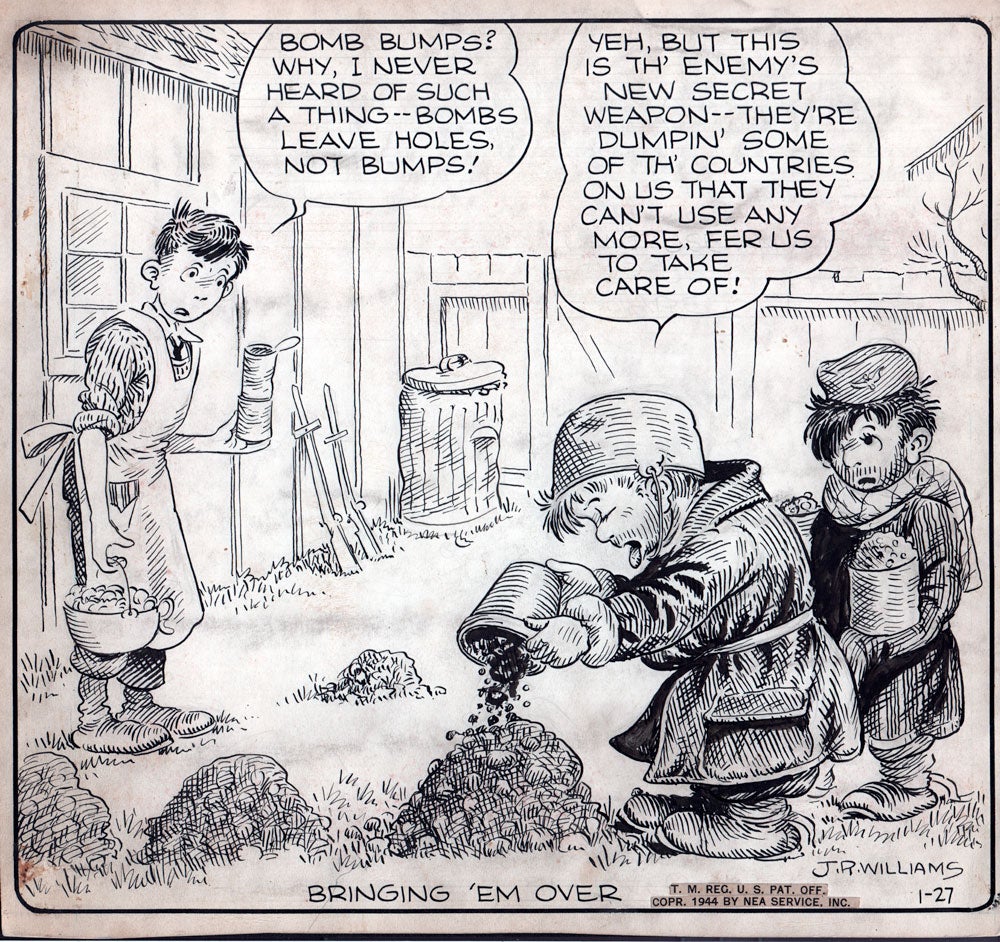
1944.01.27 “Bringing ‘Em Over” in Out Our Way by James (JR) Williams

A black-and-white comic shows two boys in a backyard. One boy pours something on the ground, saying the enemy is dumping a “secret weapon” on them. The other boy looks surprised, holding a watering can. The yard has several lumps of dirt.

1944.01.27 “Bringing ‘Em Over” in Out Our Way
by James (JR) Williams (1888-1957)
13 x 13 in., ink on board

Out Our Way first appeared in newspapers on March 20, 1922. The single-panel series introduced a variety of characters, typically labor and blue collar slice of life scenes.  Anecdotal stories indicate that more Williams’ cartoons were clipped and saved than were other newspaper comics.

I’m not 100% sure about the context for this one.

It could refer to the “War Refugee Board.”

The War Refugee Board was established by FDR on January 22, 1944 ( Executive Order 9417). The Board was formed to aid civilian victims of the Axis powers. The Board was, in the words of historian Rebecca Erbelding, “the only time in American history that the US government founded a non-military government agency to save the lives of civilians being murdered by a wartime enemy.”