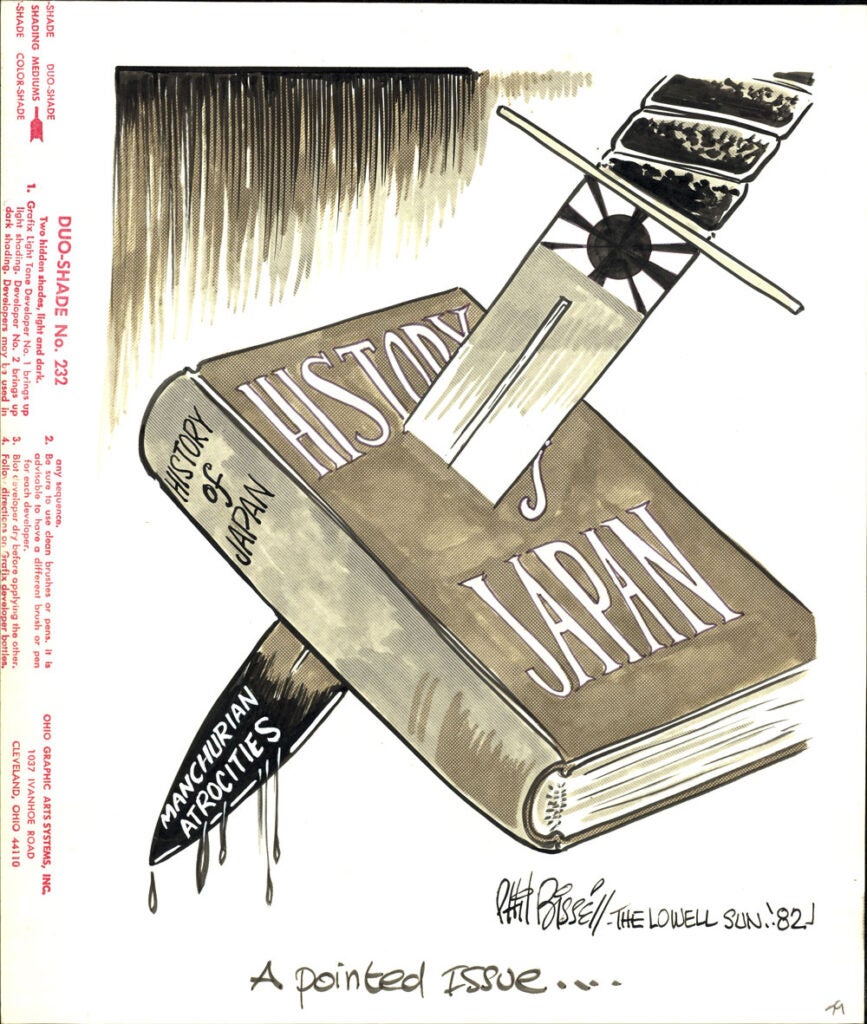
1982.08.12 “A Pointed Issue…”
by Charles Phillip Bissell (1926 -)
11 x 13, ink and wash on board
Coppola Collection
In 1960, Boston Globe cartoonist Phil Bissell, working for $25 a day, was handed an assignment that would change his life—and the lives of fans of the brand-new AFL football team coming to Boston. “Sports editor Jerry Nason came to me and he said, ‘They’ve decided to call the team the Boston Patriots. You better have a cartoon ready for tomorrow’s edition.’” Bissel’s “Pat Patriot” cartoon was the Patriot’s logo from 1961-1992.
In Japan, the depiction of history and society in school textbooks has been a long-standing controversy. Japanese conservatives, especially intellectuals, have regarded this issue as an ideological struggle against Japanese progressives who – according to the conservative view – are trying to use public education to mold students into leftist cosmopolitans who feel no affection for their country, traditions or history.
Globally, Japan’s neighbors, Korea and China in particular, have been concerned with how Japanese imperialism and invasions are depicted in Japanese textbooks.
One large textbook dispute happened in the summer of 1982, which had kicked off in April, when an article in a left-leaning weekly criticized the conservative authors of a recent best-seller book (“Problematic Junior High School Textbooks”) that attacked certain school textbooks for left-leaning tendencies.
At the same time, the national Ministry of Education (MOE) was steadily tightened control over school curriculum and textbooks. In the 1980-1981 screening, it famously ordered a distinguished historian to change various passages. The MOE comments of the author’s description of the Nanjing Massacre: “[I] cannot believe that [the Japanese Force] systematically carried out the massacre as a military force. . . . [Some] phrases such as ’in the chaos during the Japanese Force’s occupation of Nanjing, numerous Chinese soldiers and civilians became victims’ can be stated.”
In late August 1982, the Chief Cabinet Secretary stated that Japan would consider fully the criticisms of its Asian neighbors in order to promote friendship and referred to “making a correction on government responsibility.” The Miyazawa statement did not specify what measures the government would take, but the South Korean government nevertheless accepted it. The Chinese government initially insisted that it was insufficient guarantee against future revisionism in textbook screening, but eventually it too accepted Japanese pledges to make appropriate corrections.