
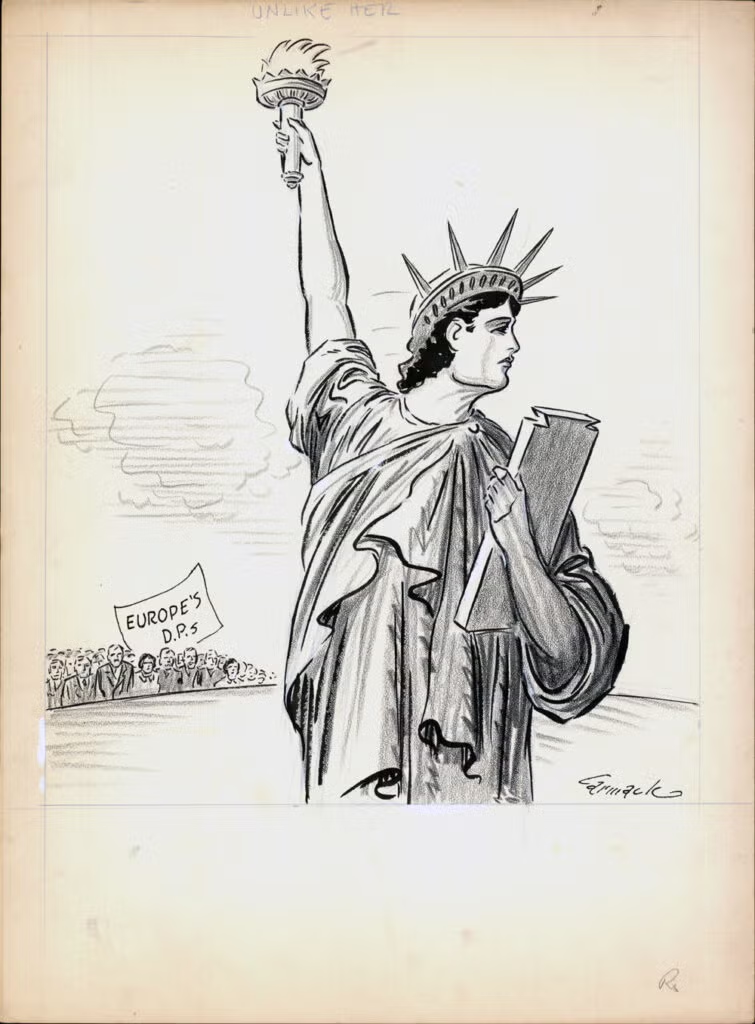
1947.07.28 “Unlike Her” by Paul R Carmack

A black-and-white drawing of the Statue of Liberty looking back at a crowd holding a sign that reads Europes D.P.s. The crowd appears to be approaching from across the water.

1947.07.28 “Unlike Her”
by Paul R Carmack (1895-1977)
11 x 15 in., ink on board
Coppola Collection

Paul Carmack was a staff cartoonist for the Christian Science Monitor.

Resettlement of the displaced persons (DPs) outside continental Europe proved to be a huge political obstacle immediately after liberation. The Allies were prepared to help the people reclaim their homes, but no one was ready to open their gates and offer the DPs new homes. Sympathy was high, but there was a strong notion that the survivors would only hamper already war-weakened domestic environments, the Allies deliberated and procrastinated for years before resolving the emigration crisis.

President Truman said in his annual message, on January 6, that the United States was not doing its part in admitting displaced persons. He urged that Congress “turn its attention to this world problem, in an effort to find ways whereby we can fulfill our responsibilities to these thousands of homeless and suffering refugees of all faiths.”

The Exodus 1947 was carrying 4,515 Jewish DPs when it was stopped by British forces on July 17, 1947. The crew and passengers resisted surrender, prompting a British attack in which three men from the Exodus 1947 were killed and many others wounded.

Hearings were held in June on a bill [HR 2910] by Rep. Stratton (R., Ill.) to permit the entrance of 100,000 refugees a year for four years but the bill had not been acted upon by either house when the session came to a close.
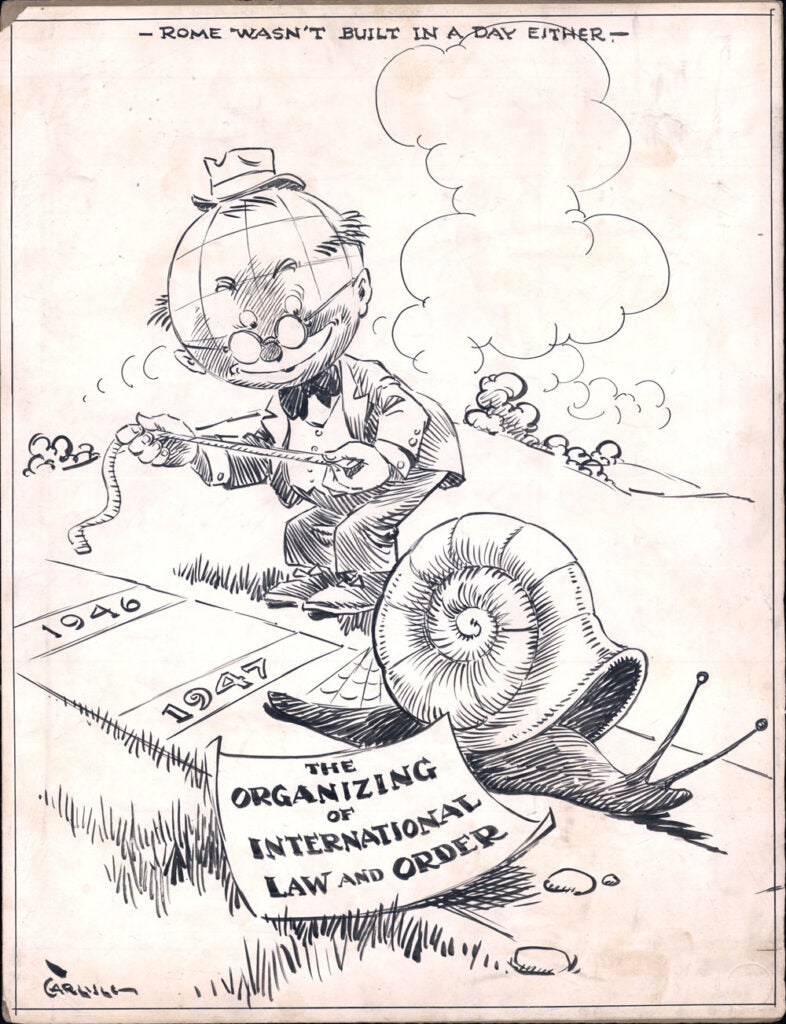
1947.06.18 “Rome Wasn’t Built in a Day Either” by Harold I “Tom” Carlisle

A cartoon of a globe-headed man in a suit marking a slow, winding path from 1946 to 1947. A large snail carries a sign reading “The Organizing of International Law and Order.” Caption: Rome wasnt built in a day either.

1947.06.18 “Rome Wasn’t Built in a Day Either”
by Harold I “Tom” Carlisle (1904-1993)
14 x 19 in., ink on board
Coppola Collection

http://digital.lib.uiowa.edu/dmrc/index-carlisle.php

Tom Carlisle grew up in Jefferson, IA, and graduated from the University of Iowa. He joined the Des Moines Register as an assistant to J.N. “Ding” Darling, the newspaper’s long-time editorial cartoonist.  After Darling’s retirement in 1949, Carlisle served as the Register’s primary cartoonist until his retirement in 1953.

Several attempts were made to codify international law after WWI. The work that led to the International Law Commission was begun in the Resolution of the Assembly of the League of Nations in 1924, which established the Committee of Experts for the Progressive

Codification of International Law, consisting of 17 members, for the purpose of making recommendations as to which issues required to be addressed in international law and the steps desirable to that end.

The name “United Nations,” coined by FDR, was first used in the Declaration by United

Nations of January 1, 1942, months after the US entry into WWII, when representatives of 26 nations pledged their governments to continue fighting together against the Axis Powers.

In 1945, representatives of 50 countries met in San Francisco at the United Nations Conference on International Organization to draw up the United Nations Charter. Those delegates deliberated on the basis of proposals worked out by the representatives of China, the Soviet Union, the United Kingdom and the United States at Dumbarton Oaks in August-October 1944. The Charter was signed on June 26, 1945, by the representatives of the 50 countries, and the final ratification was on October 24.

On December 11, 1946, The General Assembly passed Resolution 94, which called to establish a committee of legal experts to make recommendations to the UN Secretary-General on the ways the General Assembly could encourage the progressive development of international law and its codification. The committee of experts consisted of 17 members and convened from May 12 to June 17, 1947. It recommended to establish a permanent UN commission to promote these objectives.

On November 21, 1947, the UN General Assembly passed Resolution 174, which provided for the creation of an “International Law Commission” in order to fulfill the obligations of the Charter.

1947.03.24 “Somewhere in Germany” by Vaughn Richard Shoemaker

A cartoon of a German village courtyard with two soldiers in front, one saying, “Wonder how all was and rusty and coming with our peace?” The other replies, “Ach, they’re too busy trying to win on their own.” A woman watches from a balcony above.

1947.03.24 “Somewhere in Germany”
by Vaughn Richard Shoemaker (1902-1991)
13 x 16, ink and wash on board
Coppola Collection

Shoemaker was an American editorial cartoonist. He won the 1938 and 1947 Pulitzer Prize for Editorial Cartooning and created the character John Q. Public. He spent 22 years at the Chicago Daily, and subsequently worked for the New York Herald Tribune, the Chicago American, and Chicago Today. He retired in 1972.

The Molotov Plan was the system created by the Soviet Union in 1947 in order to provide aid to rebuild the countries in Eastern Europe that were politically and economically aligned to the Soviet Union. It was originally called the “Brother Plan” in the Soviet Union. It can be seen to be the Soviet Union’s version of the Marshall Plan, which for political reasons the Eastern European countries would not be able to join without leaving the Soviet sphere of influence. Soviet foreign minister Vyacheslav Molotov rejected the Marshall Plan, proposing instead the Molotov Plan.

On March 18, 1947, TASS (the Russian news agency) published the text of a secret agreement made at the Yalta Conference in 1945 on the matter of German reparations, in order to back up Molotov’s demand for them. The question then turned to whether the Yalta text was supplemented or superseded by the Potsdam Agreement.

This is a rather elegant piece of art from Shoemaker.

1947.02.20 “Already Sprouting” by Max P. Milians

A political cartoon shows a storm cloud labeled Our Wait and See Policy raining on Greece. A scythe with a Soviet hammer and sickle flies a World War III flag as bayonets pierce the ground spelling GREECE.

1947.02.20 “Already Sprouting”
by Max P. Milians (1907-2005)
11 x 14 in., ink of board
Coppola Collection

Milians signed his cartoons with nine zeros (“millions”) as an underline. His work was syndicated across America from the 1930s up until the 1970s.

So-called “International Brigades” were formed during the Spanish Civil War, 1936-1939, made up of large ideological factions that were backing one side or the other. The blueprint for how powers would interfere in other civil wars (Korea, Viet Nam) was laid down in Spain just before WW2.  The Greek Civil War of 1946–1949 echoed the Spanish conflict of a decade earlier. An earlier, left-wing resistance movement (1941-44) had been led by the Greek Communist Party, and it flared up again just after the end of WW2.

In early 1947, there was (as it turns out) wild speculation that an International Brigade would come to fight alongside the communist guerrillas, but it has been imagined as originating from the apocalyptic fears of the Greek government on whose side the United States and Britain were interested. The concern, by waiting around and not acting, was that foreign communists, including Spanish Civil War veterans, might join the Greek guerrillas.

On February 9, a report appeared in Paris about a group of French socialist volunteers who had formed and were ready to take up the cause in Greece. On March 13, US President Truman enunciated the doctrine of containing communism world-wide, starting from Greece. The Truman Doctrine became the metaphor for the containment of communist expansion and the eventual domino theory that dominated the Cold War for 30 years.