1944.12.20 “It Can’t Happen There” by William (Bill) Crawford

A referee leaps onto a chaotic battlefield with tanks and soldiers, blowing a whistle and holding a sign reading Time out for Christmas! as explosions and destruction surround him. The title It cant happen here appears at the top.

1944.12.20 “It Can’t Happen There”
William (Bill) Crawford (1913-1982)
18.5 x 22 in., ink and crayon on heavy paper
Coppola Collection

https://en.wikipedia.org/wiki/Bill_Crawford_(cartoonist)

Crawford worked as a sports cartoonist and for the Washington Daily News and the Washington Post from 1936-38. He joined the Newark News as an editorial cartoonist and his cartoons were distributed to more than 700 daily newspapers by the Newspaper Enterprise Association. He was an active member of the National Cartoonists Society, serving as its president and vice-president. In 1956, 1957, 1958, and 1963 he was awarded “Best Editorial Cartoon” by the National Cartoonist Society, and in 1973 he received their Silver T-Square Award. Crawford retired in 1977.

In WW2, there was no Christmas truce as there was during WW1. On December 7, 1941, Pope Benedict XV suggested the idea of a truce. The countries and their commanders disagreed, but on December 24, 1914, after 5 hard months of conflict, British, French and German soldiers left their trenches and exchanged gifts, food, and stories, and playing soccer. Afraid of future fraternization and sympathies, any such suggestion of truce was threatened with disciplinary action. Robert Kennedy called for a Christmas truce in 1965, during the Vietnam War, which lasted 30 hours. The Tét Truce, celebrating the lunar new year, had typically been observed by the North and South Vietnamese during that war, although that was broken in 1968 (Tét Offensive).

The Battle of the Bulge began on December 16, 1944. The Germans called this “Operation Watch on the Rhine.” The US Press dubbed this “the battle of the bulge” because of the way the troop advancements appeared on the maps.

This was to be the last major German western offensive, and lasted 5 weeks, in the Ardennes forests of Belgium, Luxembourg, and Germany. On December 24, the winter weather broke and the Allied air raids against this surprise attack halted the advance of the Nazis. Patton reached the front on the 26th, and the offensive was considered broken by the next day.

There is a great story known about a meeting that took place in a hunting cabin in the woods located near Monschau, Germany, on the border of Germany and Belgium, just south of Aachen.

Driven from Aachen because their home and business, a bakery, were bombed, Elizabeth Vincken and her son, 12-year-old Fritz, were alone in their family cabin about four miles outside Monschau on Christmas eve. Hubert Vincken, the baker, was tending to business obligations in Aachen, and had not yet rejoined his family.

A knock at the door; Elizabeth and her son were surprised to see two lost and bedraggled young American soldiers with their wounded comrade, who could have burst in and taken the cabin, but did not. She invited them in. The soldiers spoke no German, and the Vinckens no English, but they shared enough French words to communicate. Seeing their condition, she decided to fix a meal. She sent Fritz to get potatoes and the turkey (named “Hermann” out of Elizabeth’s distaste of Goering), which was being saved for their meal when her husband returned.

As Hermann was roasting, there was another knock at the door. Fritz opened it to another set of (polite) soldiers, but this time four lost armed Germans, three of them also very young, in their mid-teens. Elizabeth, fearful of the penalty for harboring the enemy, pushed past Fritz and met them outside. She said they were welcome to come in, get warm, and share a good meal, but that there were others inside whom they would not much like to see.

The German corporal (a seasoned 23 years old) asked, severely, if there were Americans in the cabins. Holding his stare, she said yes, they are as lost as you are, and one is wounded.

“It is the Holy Night,” she continued. “And there will be no shooting here.” She required them to disarm and leave their weapons outside, and went back inside, demanding the same of the Americans.

After some tense moments, the Germans produced a bottle of wine and some bread. One of the Germans, who spoke English, was also an ex-medical student. He examined the wounded soldier, whom he said needed food and rest.

The Christmas truce lasted through the morning.

The young corporal looked at the Americans’ map and gave them directions back to the front, along with his compass, telling them to avoid Monschau, which was being held by the Germans. The soldiers shook hands, retrieved their weapons, and parted in opposite directions.

The story might have been lost to history except for a speech given by President Reagan, in Germany, on May 5, 1985, at the time of the G7 Meeting.

For that story, go to the cartoon by Phillip Bissell (05/07/1985) titled “Laid to Rest, Finally.”
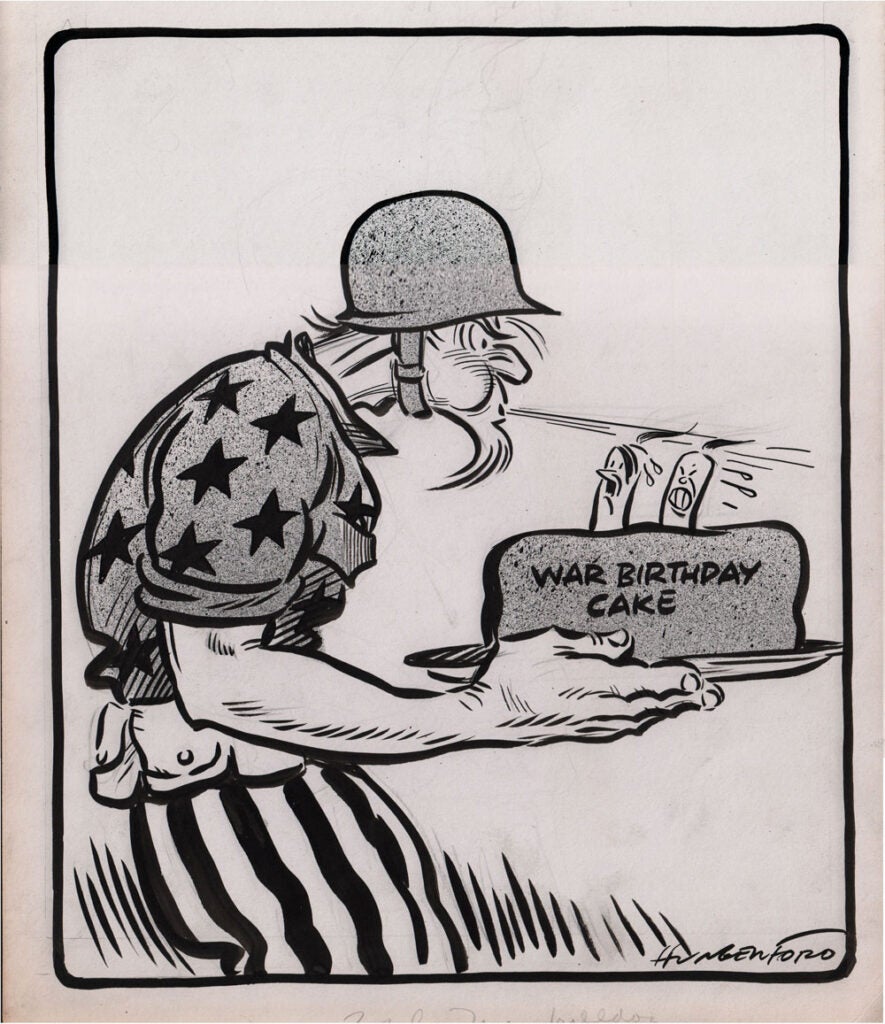
1944.12.07 “War Birthday Cake” by Cyrus Cotton “Cy” Hungerford

A cartoon figure of Uncle Sam, wearing a helmet and star-spangled shirt, presents a cake labeled War Birthday Cake with two smoking candle wicks shaped like the number 10.

1944.12.07 “War Birthday Cake”
by Cyrus Cotton “Cy” Hungerford (1889-1983)
13 x 16 in., ink on paper
Coppola Collection

https://en.wikipedia.org/wiki/Cy_Hungerford

Hungerford worked for the Wheeling (West VA) Register before becoming editorial cartoonist for the Pittsburgh Sun for fifteen years from 1912. He joined the Pittsburgh Post-Gazette in 1927 and stayed there until his retirement in 1977.

On the second anniversary of the US entry into WW2, things had been moving in favor of the Allies. On June 6, the D-Day invasion ultimately led to the liberation of Paris in late August.

Hitler’s June troubles were compounded by a Russian counterattack, which drove 300 miles west to Warsaw, and killed, wounded or captured 350,000 German soldiers. By the end of August, the Russians had taken Bucharest. Estonia was taken within months, and Budapest was under siege by the end of the year.

One glimmer of light for Germany came in the Ardennes, in France, where the December 16 German counteroffensive – the Battle of the Bulge – killed 19,000 Americans and delayed the Allies’ march into Germany.

1944.12.07 “That’s the Way to Remember It” by Milton Rawson Halladay

Black-and-white drawing of people lined up at a counter to buy war bonds on the 3rd anniversary of Pearl Harbor. A sign reads, Buy E-Bonds today. The mood is serious and patriotic.

1944.12.07 “That’s the Way to Remember It”
by Milton Rawson Halladay (1874-1961)
16 x 18 in., ink on board
Coppola Collection

Halladay was a native of Vermont and a noted political cartoonist for the Providence Journal (Rhode Island) for nearly fifty years (1900-1947). His cartoons were published in countless other newspapers and magazines. He has been called “one of the deans of American political cartooning.” His cartoon commemorating the death of Thomas A. Edison was a runner-up for the Pulitzer Prize.

These “war loan bonds” were marketed first as “defense bonds”, then later as “war bonds.” During World War II the “fun drive” technique (used during World War I) was generally replaced in part by a continual campaign using a payroll deduction plan. However, eight different drives were conducted during the war.

The first Series E bond was sold to President Franklin D. Roosevelt by Secretary of the Treasury Henry Morgenthau on May 1, 1941. The first drive took place later that year, in Nov-Dec 1942, and was more aimed at corporations and banks than individuals.

The Sixth War Loan Drive ran for less than a month, from November 20 through December 16, 1944. The drive raised $21.6 billion ($300.3 billion today). This was the second one to overlap the anniversary of the Pearl Harbor attack (the first drive overlapped the 1942 anniversary).

The Sixth War Loan Drive faced a few slight difficulties that the earlier five drives had not. By the end of 1944, with German resistance somewhat winding down, there was a sense among American citizens that the war was reaching its conclusion. There was also a bit of a fatigue factor, being asked once more to dip into your funds to buy more bonds. The Treasury Department worked hard to counter both of these beliefs. Unlike earlier drives, the Sixth had five “slogans” rather than just one, one of them being “Your Country Is Still At War—Are You?”

As an army of six million “Victory Volunteer” workers tried to meet or beat a goal of 14 billion dollars, Ted R. Gamble, National Director of the Treasury’s War Finance Division, said “the Sixth War Loan is receiving unprecedented support from the press, radio, motion picture industry, magazine publishers, retailers and the advertising industry”.

Radio would lead the way for the campaign. The President’s “Statement on The Sixth War Loan Drive,” which inaugurated the drive, was broadcast live on radio on November 19, 1944.

The country listened to the war bond fund raising Army-Navy football game live on the radio. And popular radio entertainers such as Jack Benny, Bing Crosby, Bob Hope, Eddie Cantor and more drove home the need to fund the war effort. This was booked as “the football game of the century,” and included a two-story replica of the Statue of Liberty erected in Times Square, a celebrity-filled “Radio Revue” that aired live from Madison Square Garden, hundreds of hours of radio programming, and a cross-dressing squirrel named Tommy Tucker that asked citizens to buy war bonds.

This cartoon was scheduled for Thursday, December 7, 1944. Also on December 7, during “Pearl Harbor Free Movie Day, “ admission for movies was free if you purchased a war bond. The CBS network had their Bond day on December 7, the third anniversary of the attack on Pearl Harbor. According to one report, the network incorporated the day’s theme, “Buy More Bonds” into fifty-eight programs broadcast from 6:00 am to midnight, including three special broadcasts.

On Friday December 15, 1944 eight Loews movie theaters held “Midnight Bond Premieres,” which also featured live stage shows. The theaters also held special Saturday Children’s Bond matinees, auctions and rallies.

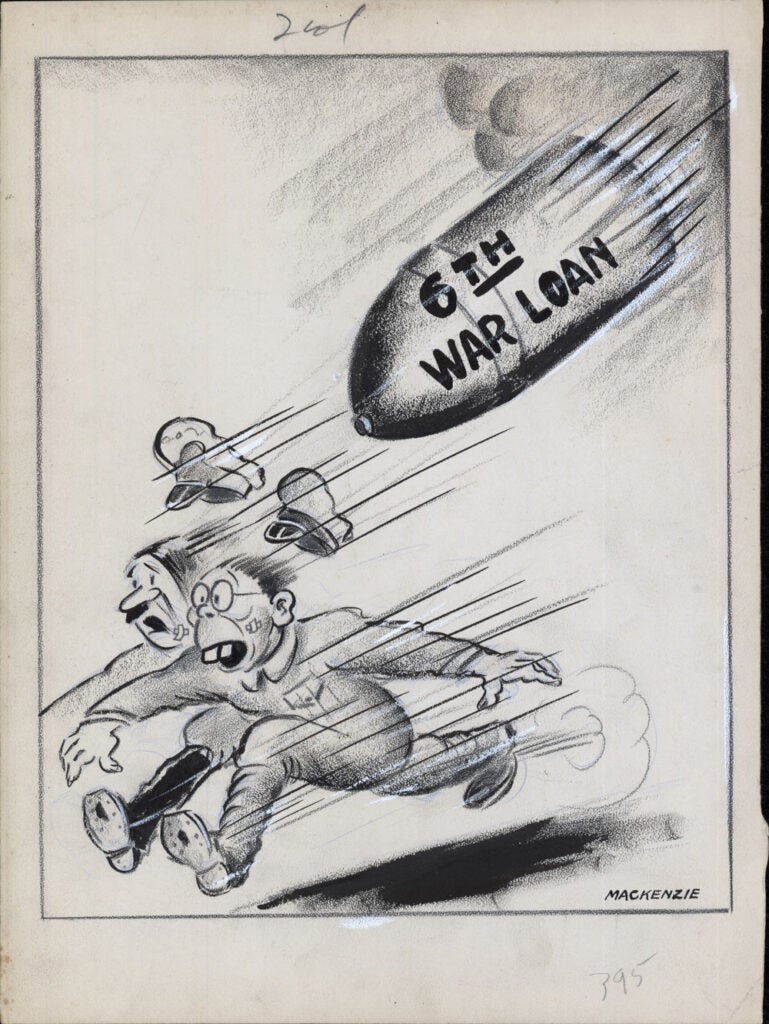
1944.11.20 “6th War Loan” by AW Mackenzie

A large missile labeled 6th War Loan zooms past, startling two frightened men in military helmets as they run, ducking in fear. The scene is drawn in a black-and-white cartoon style.

1944.11.20 “6th War Loan”
by AW Mackenzie (1895-1972)
11 x 15 in., ink on board
Coppola Collection

Mackenzie was a student of Van Dearing Perrine and attended the Art Students League about 1915. He started as a freelance cartoonist in 1941 and in May 1945, he attended the first United Nations Conference on International Organizations in San Francisco as a political cartoonist for the New York Post newspaper. His cartoons appeared daily on the editorial pages of the New York Post, Newsday and in the New York Daily.

These “war loan bonds” were marketed first as “defense bonds”, then later as “war bonds.” During World War II the “fun drive” technique (used during World War I) was generally replaced in part by a continual campaign using a payroll deduction plan. However, eight different drives were conducted during the war.

The first Series E bond was sold to President Franklin D. Roosevelt by Secretary of the Treasury Henry Morgenthau on May 1, 1941. The first drive took place later that year, in Nov-Dec 1942, and was more aimed at corporations and banks than individuals.

The Sixth War Loan Drive ran for less than a month, from November 20 through December 16, 1944. The drive raised $21.6 billion ($300.3 billion today). This was the second one to overlap the anniversary of the Pearl Harbor attack (the first drive overlapped the 1942 anniversary).

The Sixth War Loan Drive faced a few slight difficulties that the earlier five drives had not. By the end of 1944, with German resistance somewhat winding down, there was a sense among American citizens that the war was reaching its conclusion. There was also a bit of a fatigue factor, being asked once more to dip into your funds to buy more bonds. The Treasury Department worked hard to counter both of these beliefs. Unlike earlier drives, the Sixth had five “slogans” rather than just one, one of them being “Your Country Is Still At War—Are You?”

As an army of six million “Victory Volunteer” workers tried to meet or beat a goal of 14 billion dollars, Ted R. Gamble, National Director of the Treasury’s War Finance Division, said “the Sixth War Loan is receiving unprecedented support from the press, radio, motion picture industry, magazine publishers, retailers and the advertising industry”.

Radio would lead the way for the campaign. The President’s “Statement on The Sixth War Loan Drive,” which inaugurated the drive, was broadcast live on radio on November 19, 1944.

This cartoon was published on the kick-off date, November 20, 1944.

The country listened to the war bond fund raising Army-Navy football game live on the radio. And popular radio entertainers such as Jack Benny, Bing Crosby, Bob Hope, Eddie Cantor and more drove home the need to fund the war effort. This was booked as “the football game of the century,” and included a two-story replica of the Statue of Liberty erected in Times Square, a celebrity-filled “Radio Revue” that aired live from Madison Square Garden, hundreds of hours of radio programming, and a cross-dressing squirrel named Tommy Tucker that asked citizens to buy war bonds.

On December 7, during “Pearl Harbor Free Movie Day, “ admission for movies was free if you purchased a war bond. The CBS network had their Bond day on December 7, the third anniversary of the attack on Pearl Harbor. According to one report, the network incorporated the day’s theme, “Buy More Bonds” into fifty-eight programs broadcast from 6:00 am to midnight, including three special broadcasts.

On Friday December 15, 1944 eight Loews movie theaters held “Midnight Bond Premieres,” which also featured live stage shows. The theaters also held special Saturday Children’s Bond matinees, auctions and rallies.

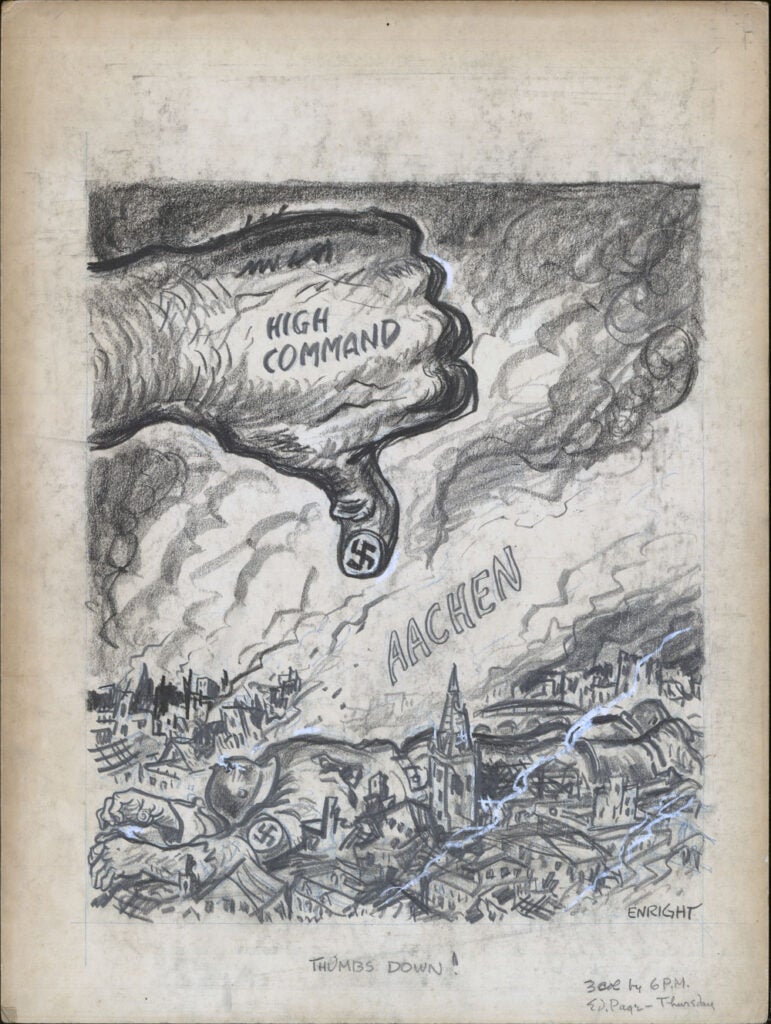
1944.10.19 “Thumb’s Down” by Walter J Enright

A large hand labeled HIGH COMMAND with a swastika on its thumb points downward over a smoking, destroyed city labeled AACHEN, with devastation, fire, and smaller swastikas scattered throughout the ruins.

1944.10.19 “Thumb’s Down”
by Walter J Enright (1879-1969)
14 x 19 in., grease pencil on board
Coppola Collection

https://www.nytimes.com/1969/01/20/archives/walter-j-enright-93-dies-former-political-cartoonist.html

A native of Chicago, Enright studied at the Chicago Art Institute. He was listed as an artist in the 1900 census, while he was still living in parents’ household in Chicago. His first wife, Maginel, was an illustrator and the younger sister of architect Frank Lloyd Wright. In addition to his work for various newspapers, he also illustrated children’s books, including at least one by Wizard of Oz author L. Frank Baum: “Father Goose’s Year Book: Quaint Quacks and Feathered Shafts for Mature Children.” Enright was with the “Miami Herald” from 1933 to 1943, and the “Palm Beach Post” from 1943 to 1948.

Sitting at the juncture of Belgium, The Netherlands, and Germany, the Nazis wasted many lives trying to keep Aachen from the Allies.

There were four major approaches to the Ruhr from France: the Plain of Flanders, the Ardennes Forest, the Metz-Kaiserlauten Gap, and the Maubeuge-Leige-Aachen axis north of the Ardennes. On September 5, 1944, Eisenhower chose the route the American armies would follow through the German defensive line known as the Siegfried Line or West Wall directly to the north and south of the ancient city of Aachen. Once Aachen and its environs were captured, the Allied high command envisioned a rapid advance to the Rhine and then on to the Ruhr with the end of the war in Europe soon following.

In September, Aachen was under the protection of Colonel Gerhard Wilck.

On October 7, 1944, US troops entered Alsdorf, six miles north of Aachen, in an initial move to encircle the city and attack it from the rear. From there the Americans pressed southward. It took 3 days to move the six miles, as the Germans poured reinforcements into its previously fortified installations around the city. By October 10 the US had reached the Aachen suburb of Haaren, a mile north of the city, and had cut the two main roads into Aachen.

Before moving in the ground troops, British bombing raids had reduced Aachen to a sea of rubble. Few of its remaining 20,000 inhabitants, down from 165,000 before the war, could have doubted that the end was near when the Americans issued the call to surrender was issued on October 10.

The Wehrmacht rejected the demand, in accord with Hitler’s “last stand” orders. Wilck took over as the city’s military commander.  A week later, following furious daily battles, the city was surrounded by Allied troops, and on October 18, the US forces started their move to take the city itself.

As the Allies moved in, Colonel Wilck issued a proclamation exhorting his command to “fight to the last man.” Too little, too late… by the end of October 19, the German high command had decided to withdraw.

On October 20, Wilck decided to end the fight for Aachen. When American soldiers entered the bunker, Wilck and his staff had already packed their bags and were ready to go. As the Germans left the bunker, Staff Sergeant Ewart M. Padget, a former prisoner, newly released, nabbed the prize souvenir of the occasion, Colonel Wilck’s service pistol.

As one America observer later wrote, the city is “as dead as a Roman ruin, but unlike a ruin it has none of the grace of gradual decay…. Burst sewers, broken gas mains and dead animals have raised an almost overpowering smell in many parts of the city. The streets are paved with shattered glass; telephone, electric light and trolley cables are dangling and netted together everywhere, and in many areas wrecked cars, trucks, armored vehicles and guns litter the streets….”

A real measure of the fight was the telling cost to the Germans. The US took 12,000 German prisoners, including 3,473 captured within the city. The Wehrmacht was starting to squander its resources with no achievement, moving by hollow dictates and compulsion.

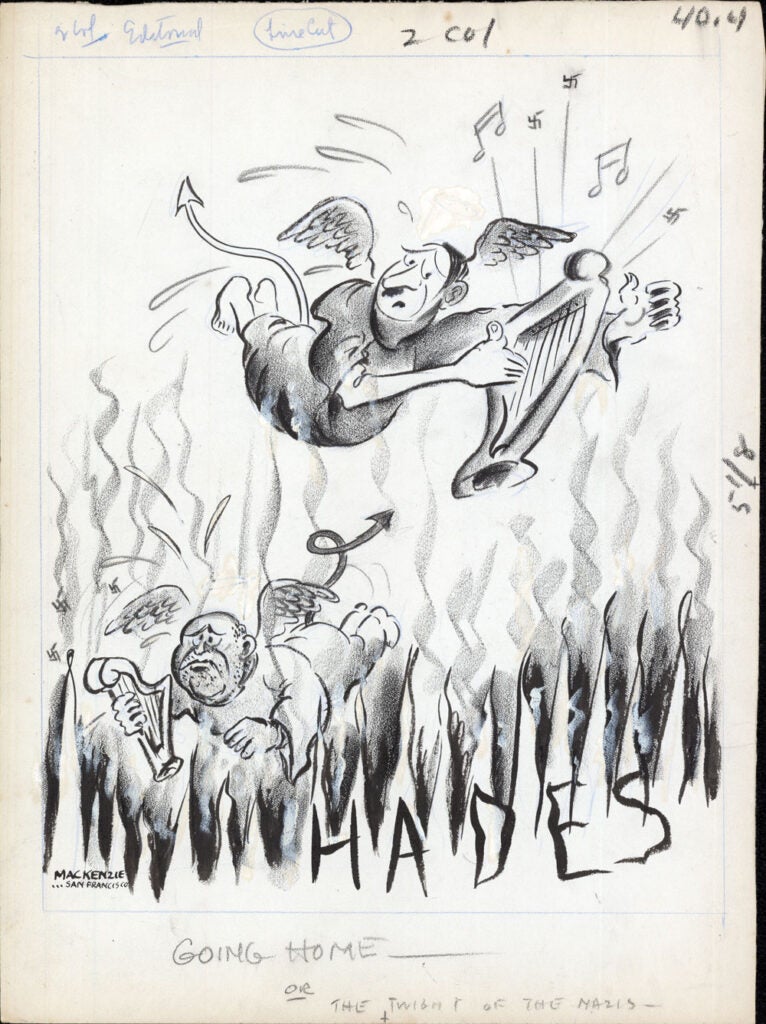
1944.09.09 “Going Home” by AW Mackenzie

Editorial cartoon by MacKenzie, San Francisco. Titled Going Home, or The Twilight of the Nazis. Two winged figures with swastikas play harps amid flames labeled Hades.

1944.09.09 “Going Home”
by AW Mackenzie (1895-1972)
11 x 15 in., ink on board
Coppola Collection

Mackenzie was a student of Van Dearing Perrine and attended the Art Students League about 1915. He started as a freelance cartoonist in 1941 and in May 1945, he attended the first United Nations Conference on International Organizations in San Francisco as a political cartoonist for the New York Post newspaper. His cartoons appeared daily on the editorial pages of the New York Post, Newsday and in the New York Daily.

No date on this one. Mussolini had been removed from power in July 1943, and he is already in hell. It is cliché, but the June 1944 D-Day invasion, coupled with Operation Bagration (the larger scale Russian assault on the Eastern front) were note- and newsworthy to the public.

One footnote on this drawing: the artist originally gave Mussolini and Hilter fake halos, and there was a editorial decision to white those out. You can see Mussolini’s on the detail panel in the Additional Images.

1944.08.20 “Paris” by Gordon Campbell

A cartoon shows two soldiers in a tank passing a “Paris” sign. One asks, “Arent we stopping at Paris, General Patton?” The other replies, “Nope, Berlin!” Explosions and smoke fill the background.

1944.08.20 “Paris”
by Gordon Campbell
8 x 11 in., ink on paper
Coppola Collection

This one is a mystery. I have a feeling it could be a retrospective commemoration rather than a cartoon contemporary to 1944. Putting the notation “WWII” seems a little curious (unless it is modern). I could be wrong. Other than the Canadian and strictly-not-this-artist Gordon Campbell, I have not tracked down who this might be. CAF member George Hagenauer has a color “Gordon Campbell” page that is thought to be a try-out strip (“Rita Ray”) but that’s it so far.

The liberation of Paris took place during World War II from August 19-25, 1944, resulting in a German garrison surrendering at the French capital. Paris had been ruled by Nazi Germany since the signing of the Armistice on June 22, 1940, after which the Wehrmacht occupied northern and western France. The liberation began when the French Resistance staged an uprising against the German garrison upon the approach of the US Third Army, led by General George Patton.

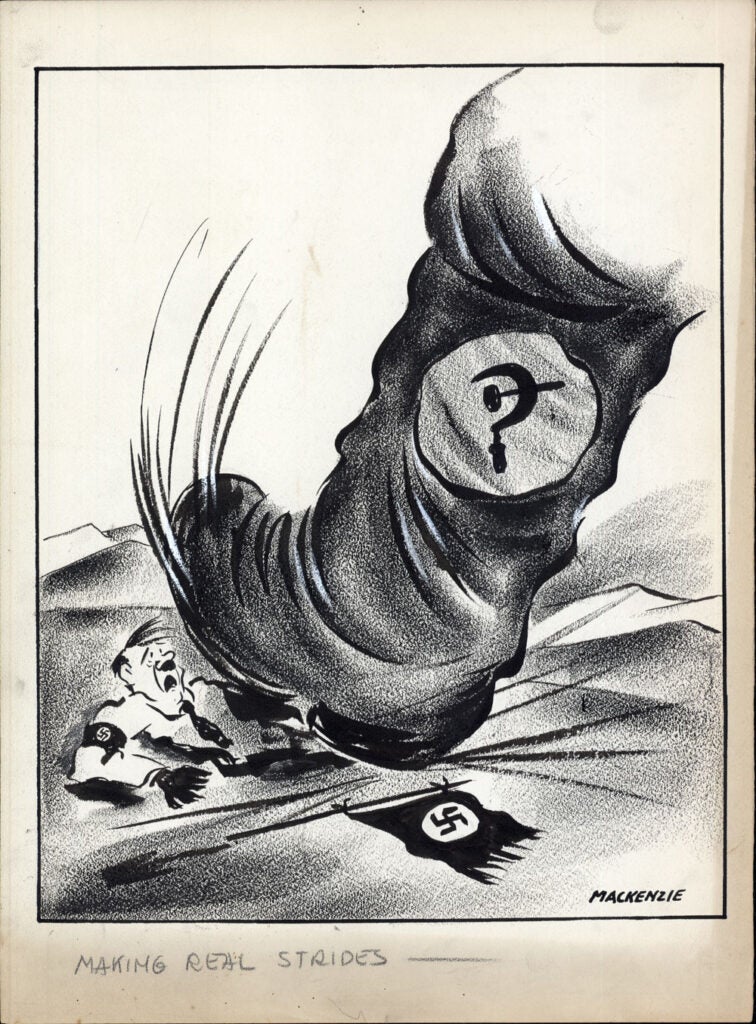
1944.07.08 “Making Real Strides” by AW Mackenzie

A large boot with a question mark on its sole stomps toward Hitler, who falls backward in fear. A Nazi flag is crushed beneath the boot, and the caption reads, MAKING REAL STRIDES.

1944.07.08 “Making Real Strides”
by AW Mackenzie (1895-1972)
11 x 15 in., ink on board
Coppola Collection

Mackenzie was a student of Van Dearing Perrine and attended the Art Students League about 1915. He started as a freelance cartoonist in 1941 and in May 1945, he attended the first United Nations Conference on International Organizations in San Francisco as a political cartoonist for the New York Post newspaper. His cartoons appeared daily on the editorial pages of the New York Post, Newsday and in the New York Daily.

A notation about “Bagration” on the back puts this into context.

Because we write our own histories, particularly of wars, the D-Day Invasion is embraced by the West as the beginning of the end of WW2. Operation Overlord (starting June 6, 1944, and going into August) was the codename for the Battle of Normany, which began with Operation Neptune, the “D-Day” Normany landings.

What is missing from that story is the coordination with the Russians, who were taking on a parallel and coordinated attack on the Eastern Front at exactly the same time.

In Operation Bagration (June 23, 1944), the Russians set out to retake Byelorussia (now Belarus), and in the process, destroy the Army Group Center (the name for the coordinated Nazi efforts in the East). The scale of the operation, in the words of some contemporary historians, makes D-Day “look like a skirmish.”

The Wehrmacht had 58 divisions in the west, of which only 11 were deployed against the D-Day landings. At the same time, however, the Germans deployed 228 divisions in the east. Thus, the Germans had almost four times as many troops facing the Soviets. And they had less than 1/20 of that number in Normandy. That alone is an indication of where their priorities lay.

At no time after June 6, 1944, did the German high command contemplate transferring forces from the east to the west to counter the Normandy landings. The battle has been described as the triumph of the Soviet theory, as their front commanders left their adversaries completely confused about the main axis of attack until it was too late.’

As Eisenhower broke though at Normany and liberated Paris and then Brussels, Nazi Germany finally needed to be fighting a two-front war in northern Europe. It is no coincidence that on July 20, 1944, dissident officers tried to assassinate the Hitler (for the movie version of this story, see Operation Valkyrie) in a bid to make peace before Germany was ruined.

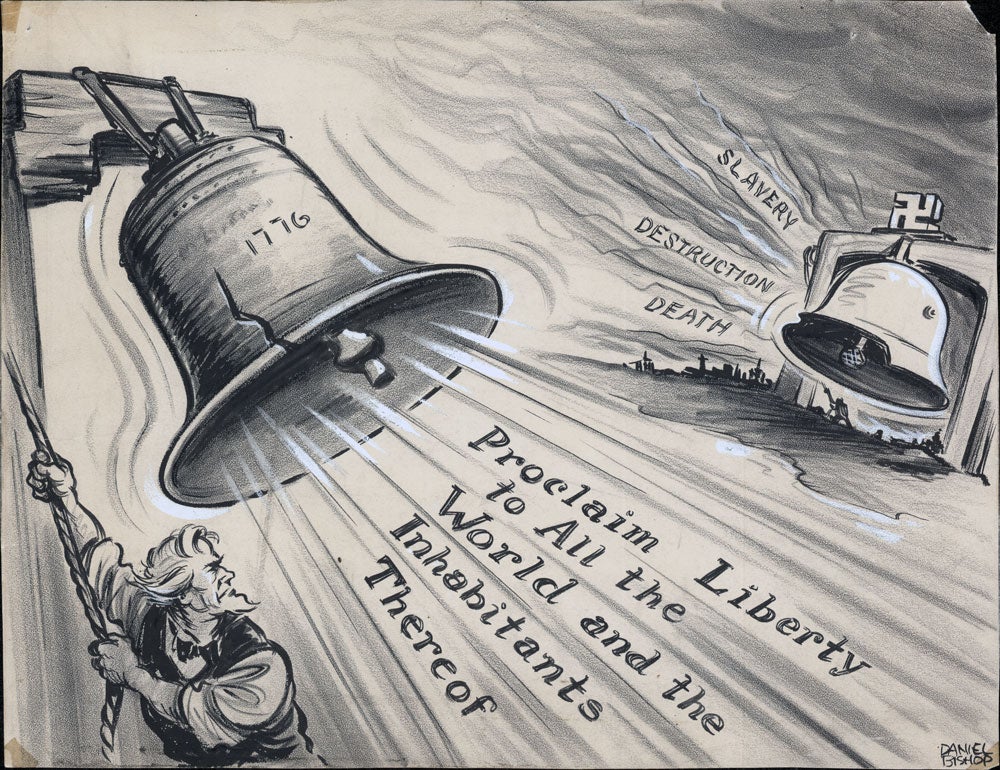
1944.07.04 “One Rings While the Other Tolls” by Daniel Sanborn Bishop

A person rings the Liberty Bell, radiating light and the words “Proclaim Liberty to All the World and the Inhabitants Thereof.” In the distance, a Nazi bell emits beams labeled Slavery, Destruction, Death.

1944.07.04 “One Rings While the Other Tolls”
by Daniel Sanborn Bishop (1900-1959)
15 x 17 in., ink on board
Coppola Collection

Bishop studied at the Chicago Academy of Fine Arts. After graduating, Bishop joined the Oregon Journal as its editorial cartoonist in 1920 and then moved to the St. Louis Star Times in 1925. He played the trumpet in his spare time and was a member of the Portland Symphony Orchestra.

Following the D-Day invasion of June 1944, the Allies broke out of Normandy and advanced rapidly across France and Belgium. Hitler aimed to halt them by a surprise Blitzkrieg. Several armored divisions massed in the Ardennes with the goal of breaking through Allied lines. American forces held on stubbornly in spite of heavy casualties— more than 19,000 died. The Germans had limited supplies and could only fight for few days to before fuel and ammunition ran out, so the offensive soon ran out of steam. Allied lines “bulged” but did not break, and hundreds of thousands of reinforcements poured into the area. Afterwards, Germany lacked resources for another offensive and the end was inevitable.

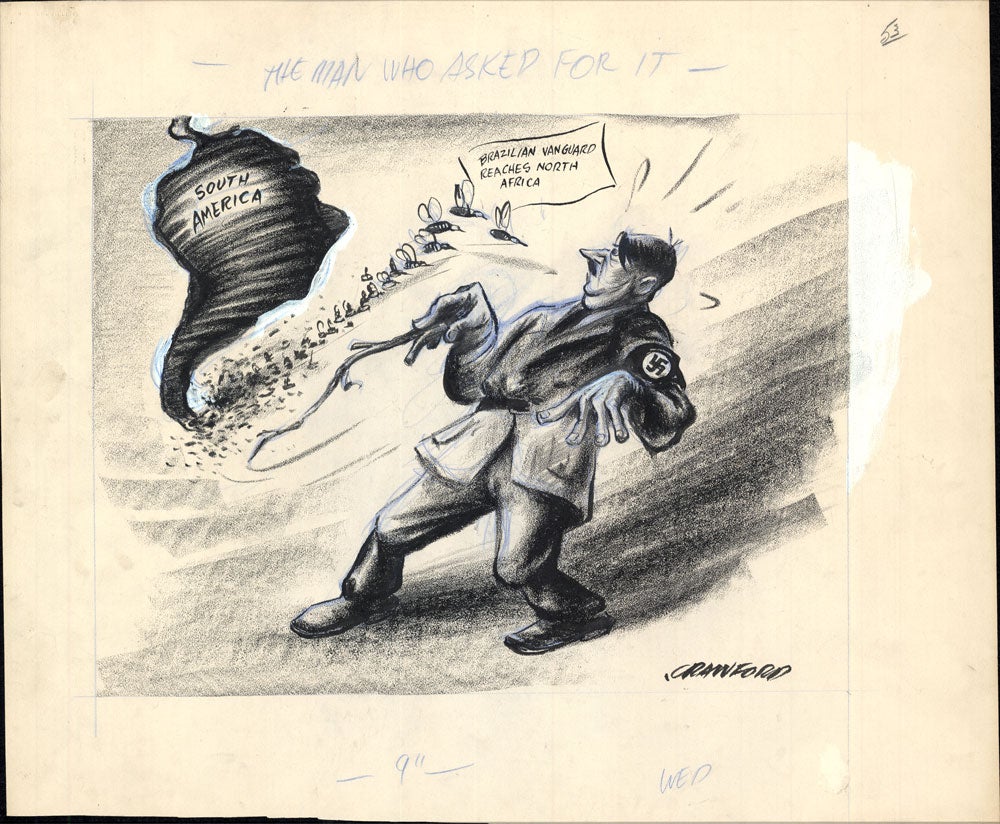
1944.07.31 “The Man Who Asked for It” by William (Bill) Crawford

A caricature of a Nazi officer recoiling in fear as a large, animated whip labeled Brazilian War Bird strikes him from South America. The continent is shown with whip marks reaching toward the officer.

1944.07.31 “The Man Who Asked for It”
by William (Bill) Crawford (1913-1982)
18.5 x 22.5 in., ink and crayon on heavy paper
Coppola Collection

https://en.wikipedia.org/wiki/Bill_Crawford_(cartoonist)

Crawford worked as a sports cartoonist and for the Washington Daily News and the Washington Post from 1936-38. He joined the Newark News as an editorial cartoonist and his cartoons were distributed to more than 700 daily newspapers by the Newspaper Enterprise Association. He was an active member of the National Cartoonists Society, serving as its president and vice-president. In 1956, 1957, 1958, and 1963 he was awarded “Best Editorial Cartoon” by the National Cartoonist Society, and in 1973 he received their Silver T-Square Award. Crawford retired in 1977.

Brazil was underdeveloped in the 1930s, with a mediocre military and poor infrastructure.

Yet, the tip of Brazil is one end of the shortest distance across the Atlantic from Nazi-occupied Africa, at 1600 miles. So the fear of Brazil being the beachhead for an invasion of the Americas was real.

By early 1944, the Brazilian Expeditionary Force (BEF) had been formed, and local soldier were being trained by a combination of American and British advisors. On July 30, 1944, the first BEF troops embarked at Rio de Janeiro to cross the Atlantic and complete training in Africa, moving from there to join the US in Italy. From September 15 to October 30, 1944, the Brazilians relieved American troops in the Serchio Valley, near Pisa and Livorno on the coast, and have successive victories retaking small provinces in the area, capturing about a 30-mile swath.