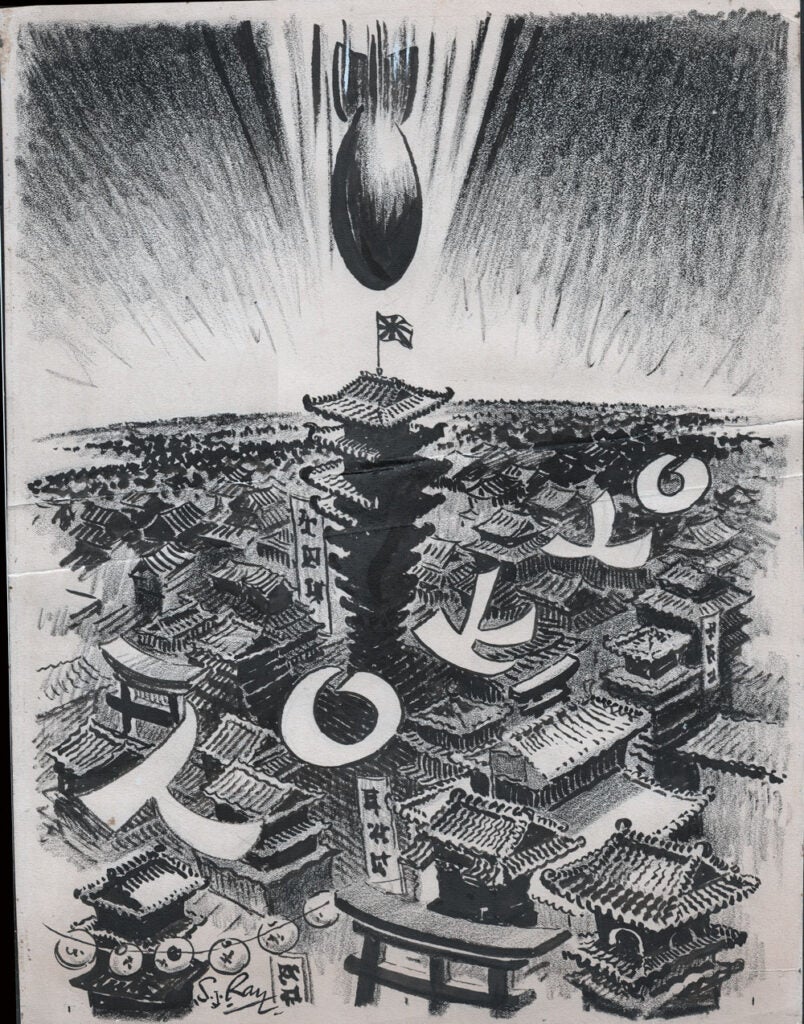
1945.03.12 “What a Target” by Silvey Jackson (SJ) Ray

A large bomb drops from the sky toward a traditional Japanese city labeled Tokyo, where buildings and pagodas are tightly packed. The bomb’s path is dramatic, and citizens below appear shocked or panicked.

1945.03.12 “What a Target”
by Silvey Jackson (SJ) Ray (1891-1970)
12 x 16 in., ink on board
Coppola Collection

S.J. Ray was a student at the Art Students League of New York and was a World War I veteran. He joined the Kansas City Star in 1915 as an advertising illustrator and became the Star’s editorial cartoonist in 1931. He served in that post until retirement in 1963,

drawing an estimated 10,000 cartoons. He received honors from the U.S. Treasury Dept. for his cartoons during World War II in behalf of the National War Savings Program.

The Bombing of Tokyo was a series of firebombing air raids by the United States Army Air Forces during the Pacific campaigns of World War II. Operation Meetinghouse, which was conducted on the night of March 9-10, 1945, is regarded as the single most destructive bombing raid in human history: 16 square miles of central Tokyo were destroyed, leaving an estimated 100,000 civilians dead and over 1 million homeless.

Over 50% of Tokyo’s industry was spread out among residential and commercial neighborhoods; firebombing cut the whole city’s output in half.  Some post-war analysts have called the raid a war crime due to the targeting of civilian infrastructure and the ensuing mass loss of civilian life.

Emperor Hirohito’s tour of the destroyed areas of Tokyo in late March was the beginning of his personal involvement in the peace process, culminating in Japan’s surrender six months later.

1945.06.22 “Another Break in the Jap Line” by AW Mackenzie

A caricature of a panicked man in a swastika-covered robe labeled Jap War Machine teeters on a unicycle over a chasm. He holds a broken umbrella, with a whip labeled Okinawa knocking him off balance.

1945.06.22 “Another Break in the Jap Line”
by AW Mackenzie (1895-1972)
12 x 15 in., ink on board
Coppola Collection

Mackenzie was a student of Van Dearing Perrine and attended the Art Students League about 1915. He started as a freelance cartoonist in 1941 and in May 1945, he attended the first United Nations Conference on International Organizations in San Francisco as a political cartoonist for the New York Post newspaper. His cartoons appeared daily on the editorial pages of the New York Post, Newsday and in the New York Daily.

The drawing is undated. The Battle of Okinawa (Operation Iceberg) was a major battle of the Pacific War fought on the island of Okinawa by United States Marine and Army forces against the Imperial Japanese Army. The initial invasion of Okinawa on April 1, 1945, was the largest amphibious assault in the Pacific Theater of World War II. The 82-day battle lasted from April 1 until June 22, 1945. The Allies were planning to use Kadena Air Base on the large island of Okinawa as a base for Operation Downfall, the planned invasion of the Japanese home islands, 340 miles away.

1945.06.12 “The Wild Man of Borneo” by Burris A. Jenkins, Jr.

A cartoon man in swimming trunks and cap leaps in alarm from a treasure chest labeled “Fabulous Wealth of Borneo,” as a huge sword labeled “MacArthur’s Aussies” crashes down behind him in a jungle setting.

1945.06.12 “The Wild Man of Borneo”
by Burris A. Jenkins, Jr. (1897-1966)
15 x 18 in., ink and crayon on board
Coppola Collection

http://www.original-political-cartoon.com/cartoon-gallery/artists/jenkins-jr-burris-1897-1966/

Burris Jenkins Jr. was the son of a prominent Kansas City minister, war correspondent and newspaper editor. Jenkins Jr. was a popular sports cartoonist, whose work appeared in the New York Journal-American from 1931. His humorous published verses were also popular. Although best known for his sports themes, Jenkins was also a skilled courtroom illustrator and editorial cartoonist.

Jenkins was not afraid to provoke, and he has some strong WW2 examples, including one of the rare direct commentaries on concentration (death) camps. Among his best-remembered cartoons are his angry piece on the discovery of the dead Lindbergh baby, and his sentimental image of Babe Ruth’s farewell to Yankee Stadium.

He was fired from his first job at the Kansas City Post for a series of pessimistic Christmas cartoons, a firing that prompted his father’s resignation from the same newspaper.

His father was an interesting guy. Jenkins, Sr (1968-1945) was ordained in 1891 and served as a pastor in Indianapolis. He received advanced degrees from Harvard and went on to serve as a professor and president of the University of Indianapolis and president of Kentucky University. He left Kentucky to return to Kansas City as pastor of the Linwood Boulevard Christian Church. The church burned in 1939, and Jenkins chose Frank Lloyd Wright as the architect for the church’s new home overlooking the Country Club Plaza.

Jenkins served as editor of the Kansas City Post from 1919 to 1921, hoping to fight for the establishment of the League of Nations. The Jenkins, Sr., biography tells the story about his leaving the Post slightly differently that for the son: “After two years, it became necessary for him to choose between the newspaper and his pulpit and, without hesitation, he resigned from the Post.”

“Live dangerously!” Jenkins would thunder from the pulpit, embracing his own philosophy against all adversaries. Unconventional in nearly every aspect of his chosen field, Jenkins often preached from non-Biblical texts, such as the latest book or his travels abroad. The church frequently hosted motion pictures, dances, card games, and fundraising boxing matches. These activities led to opposition to Jenkins and his Community Church from other churches in the city.

The island of Borneo, with its oilfields and strategic location for the offensive against British Malaya and Dutch Java, was one of the prime targets of Japan’s military offensive of 1941-42. The Japanese systematically and swiftly secured their objectives in Borneo during the early months of their push into the resource-rich Southern Area (South-East Asia) following Pearl Harbor.

In 1945 the task of retaking from the Japanese the former British Borneo territories of Sarawak, Brunei, and North Borneo (Sabah) was entrusted to the Australian Imperial Force (AIF). The 20th and 24th Brigades of the 9th Division launched an amphibious offensive, codenamed OBOE 6.

In order to facilitate his re-conquest of the Philippines, MacArthur struck a deal with the Dutch that he be given “complete authority in the East Indies during any military operations.” In return, he promised to restore Dutch authority in their colonies as rapidly as possible. Therefore, the recapture of the Netherlands East Indies, particularly Java, became part of MacArthur’s plans. The seizure of Borneo was to offer bases to launch his offensive against Java. Furthermore MacArthur argued that the Bornean oilfields would be denied the enemy and instead deployed to Allied advantage.

Nonetheless MacArthur had no intention of committing American land forces in the Borneo campaign. Instead, Australian troops would spearhead the offensive there. Two main landings were undertaken by the Australians in North Borneo on June 10 and June 20.

1945.05.25 “Say A-Ah…” by Frederick Little Packer

A cartoon shows Uncle Sam as a doctor holding a bottle labeled Compulsory Health Insurance, telling a small, thin man in tattered clothes to say A-AH. The man replies, A-AH—More Taxes.

1945.05.25 “Say A-Ah…”
by Frederick Little Packer (1886-1956)
14 x 22 in., ink on heavy paper
Coppola Collection

https://en.wikipedia.org/wiki/Fred_L._Packer

Packer worked at the LA Examiner from 1919-1931, and then moved to the New York Daily Mirror in 1932.

His cartoons and posters for the World War II defense effort earned him citations from the Treasury Department and the War Production Board. He was awarded the Pulitzer Prize on May 5, l952 for his Truman Cartoon, “Your Editors ought to have more sense than to print what I say,” which appeared in the “New York Daily Mirror” of October 6, l951.

In August 1953, he was invited by the Library of Congress to make a gift of his original drawings to its permanent collection.

The campaign for some form of universal government-funded health care has stretched for nearly a century in the US. On several occasions, advocates believed they were on the verge of success; yet each time they faced defeat. Remarkably, the conservative lobby uses the same argument every time: the programs are a slippery slope towards institutionalized socialism.

Between 1906-1915, the “American Association of Labor Legislation” and the “American Medical Association” partnered on a bill. Rallying against it: the AFL repeatedly denounced compulsory health insurance as an unnecessary paternalistic reform that would create a system of state supervision over people’s health. They apparently worried that government-based insurance system would weaken unions by usurping their role in providing social benefits. The commercial insurance industry was also opposed. This effort came to an end when the US entered WWI and anti-German fever rose. The government-commissioned articles denouncing “German socialist insurance” and opponents of health insurance assailed it as a “Prussian menace” inconsistent with American values.

The Great Depression did not help for passing compulsory health insurance in the US. With millions out of work, unemployment insurance took priority followed by old age benefits. The FDR administration feared that including health care would jeopardize the entire Social Security legislation.

The Wagner National Health Care Act (1939) was introduced after the 1938 election put a resurgence of conservatives into office, and it died on the vine. Interestingly, a version of it was introduced for the next seven years.

The next major attempt, in 1943, was the Wagner-Murray-Dingell Bill. Although there was always a lot of debate, the coalition of organized labor, progressive farmers, and liberal physicians were constantly red baited as supporting socialist ways.

After FDR died in 1945, and Truman became president, the health care issue moved into the center arena of national politics and received the unreserved support of the new president. But the opposition had acquired new strength in the post-war world. Compulsory health insurance became entangled in the Cold War and its opponents were able to make “socialized medicine” a symbolic issue in the growing crusade against Communist influence in America.

On May 24, 1945, Wagner introduced, with Senator Murray, S. 1050, entitled “The Social Security Amendments of 1945.”  The bill provides for “the national security, health and public welfare.” Representative Dingell of Michigan introduced a companion bill (H. R. 3293) in the House at the same time. Wagner: “I particularly invite your earnest study of the provisions of the bill relating to health. There is absolutely no intention on the part of the authors to ‘socialize’ medicine, nor does the bill do so. We are opposed to socialized medicine or to state medicine.” The bill never made it out of the Senate.

In 1945, the AMA spent $1.5 million on lobbying efforts, which at the time was the most expensive lobbying effort in American history. They had one pamphlet that said, “Would socialized medicine lead to socialization of other phases of life? Lenin thought so. He declared socialized medicine is the keystone to the arch of the socialist state.”

The birth of the People’s Republic of China (1948), the growing threat of the Soviet Union, the Korean conflict and the backdrop of the McCarthy era, all combined to kill national health care as an issue until the focus on the elderly emerged as an action item in LBJ’s New Society, resulting in Medicare and Medicaid (1965).

1945.03.30 “Anyone Seen a German ‘Band’?” by Samuel (Sammy) Garnet Smith Wells

A cartoon shows a woman in German folk dress, labeled Germania, singing loudly and breaking glass with her voice. Nazi leaders look away as Nazi symbols labeled 1940 SUCCESSES, DEFEATS, and LOSSES fall from a balcony.

1945.03.30 “Anyone Seen a German ‘Band’?”
by Samuel (Sammy) Garnet Smith Wells (1885-1972)
17 x 21 in., ink on board
Coppola Collection

Samuel Garnet Smith Wells was born in North Sydney, New South Wales.

The earliest evidence of Wells’ capacity for artistic drawing was in 1911 when he was a Bombardier member of the Royal Australian Garrison Artillery at the Queenscliff Fort. He joined the staff of Melbourne Punch (1922) after the First World War and later he worked for the Melbourne Herald drawing sporting cartoons. In about 1923 he put out a book of cartoons based on his work at the Herald called Wells Cartoons. Wells left the Herald in 1933 to work in England on the Manchester Daily Dispatch. In 1939, fearing Britain would lose the war against Nazi Germany, he returned to Australia to take on the job of principal political cartoonist at the Melbourne Herald, a position he held until 1950 (compulsory retirement age). Wells then took a job drawing sporting cartoons for The Age until 1967. Richard Berry purchased the majority of Wells’ original works at a Melbourne estate auction in the mid 1980s.

The US Army crossed the Rhine on March 22, and the British (Operation Plunder) carried out their invasion the next day.

Diary entries from the German leadership, seen years later, would affirm the handwriting-on-the-wall fear that the end was near. Within 5 days, the Operation was over, and as the historical accounting puts at least 30,000 German POWs taken by the Allies.

Here we have a take on an old German folk song, part of which goes like this:

“Come and hear the German band, German band, German band!

Oh, the weather is so grand for the big parade!”

In the first panel, Hitler, Goering, and Goebbels are trumpeting their victories throughout 1940. By the second panel, Germany is worse for wear and there is nothing coming out of the leadership after the British invasion.

The song is famously parodied by Mel Brooks in “The Producers” in the number “Haben Sie Gehört Das Deutsches Band?”

1945.03.27 “Victory in the Meeting of Two Fronts” by Gordon Smith

A cartoon shows a frightened Adolf Hitler being trapped by giant hands labeled West Front and East Front that are closing in on him with a compass-like tool.

1945.03.27 “Victory in the Meeting of Two Fronts”
by Gordon Smith
8 x 8 in., ink and wash on board
Coppola Collection

This cartoon is attributed to the Boston Post, but I cannot track the artist, yet. At least the signature is clear.

Here, we are late in the war in Europe.

At the start of the war, in the late 1930s and into 1940, the border with the Soviet Union was quiet, thanks to the Molotov-Ribbentrop pact, signed barely a week before the invasion of Poland that started WW2, and all the while Germany conquered Denmark, Norway, France, the Low Countries, and the Balkans.

Some historians say Stalin was fearful of war with Germany, or just did not expect Germany to start a two-front war, and he was reluctant to do anything to provoke Hitler. Others say that Stalin was eager for Germany to be at war with capitalist countries. Another viewpoint is that Stalin expected war in 1942 (the time when all his preparations would be complete) and stubbornly refused to believe its early arrival. Everyone agrees that Hitler had always intended to renege on his pact with the Soviet Union, eventually making the decision to invade in the spring of 1941.

Fast forward. The two-front war is likely one of the major strategic errors made by the Nazis. With Stalin to the East, Churchill to the West, the expansion to Africa failed, and the Italians lost to the cause of fascism and the US having poured in through Sicily, the end of the war Europe moved from and uncertain “if” to deliberate “when.”

After the successful Allied invasions of western France, Germany gathered reserve forces and launched a massive counter-offensive in the Ardennes, which collapsed by January, in the Battle of the Bulge. And at the same time, Soviet forces closed in from the east. The bombing of Dresden happened in mid-February.

Operation Plunder was a military operation to cross the Rhine on the night of March 23, 1945, launched by Bernard Montgomery and William H. Simpson for the US, and by Sir Miles Dempsey for the UK. Notably: “I drove to the Rhine River and went across on the pontoon bridge. I stopped in the middle to take a piss and then picked up some dirt on the far side in emulation of William the Conqueror.” General George S. Patton, March 22, 1945. There is an image (look for it, you will find it) that purports to show Patton in the act. The image is blurred, and clearly a copy of a copy. Original versions of the picture do not, unfortunately, capture the stream.

By the end of March 1945, Western Allied forces crossed the Rhine River and the Red Army had meanwhile entered Austria, with both fronts quickly approached Berlin.

Germany put up a fierce defense, but rapidly lost territory, ran out of supplies, and exhausted its options. In April, Allied forces pushed through the German defensive line in Italy. East met West on the River Elbe on April 25, 1945, when Soviet and American troops met near Torgau, Germany. Hitler’s suicide was April 30.

1945.03.24 “Little Man, What Now?” by Sy Moyer

A soldier stands with a rifle on a dark, smoky ground labeled “Manila,” looking over his shoulder at distant American flags and city lights in the background. The scene appears tense and uncertain.

1945.03.24 “Little Man, What Now?”
by Sy Moyer (1887-1980)
9 x 11 in., pen and crayon on board
Coppola Collection

Moyer was an editorial and sports cartoonist for the Minneapolis Tribune and St Paul Dispatch.

Moyer is listed in a few places as being “1926-2016” but I am skeptical. There is another artist, a painter, named Sy Mohr, who is listed as 1926-2016 in a few places (but who was really born in 1923).

By the 1940s, the cartoonist Moyer seems to have been pretty well established, he was notes for his depiction of the Asian Enemy, and there are images of his well-worn work-desk which are unlikely for a 20-year-old.

This record exists: “SY MOYER was born 13 September 1887, received Social Security number 474-09-0126 (indicating Minnesota) and, Death Master File says, died August 1980.”

The Battle of Manila (Feb 3 – Mar 3 1945) was a brief and major battle of the Philippine campaign. It was fought by American forces from both the U.S. mainland and the Philippines against Japanese troops in Manila, the capital city of the Philippines.

The battle ended the almost three years of Japanese military occupation in the Philippines (1942–1945). The city’s capture was marked as General Douglas MacArthur’s key to victory in the campaign of reconquest.

The title (Little Man, What Now?) is an homage to a quite famous novel from pre-war Germany that documents the conditions in a turmoil-filled country on the brink. It was almost inadvertently critical of the rising Nazi ethos, to a degree that the text, well-known and in print, was edited in its later editions to revise references to the Nazis being seen in a bad light. As a colloquial saying, “Little Man, What Now?” took on that sense of impending doom at the rise of history-changing events, here a message to Japan as the war in Europe was on its last legs (this is a month before VE Day).

1945.03.19 “Watch on the Rhine” by Charles (Chuck) Werner

A Roman soldier labeled WAR stands guard with a sword and shield, watching across a river toward a distant town. Text above reads, WATCH ON THE RHINE. The scene is drawn in black and white.

1945.03.19 “Watch on the Rhine”
by Charles (Chuck) Werner (1909-1997)
12 x 16 in., ink and crayon on textured paper
Coppola Collection

https://en.wikipedia.org/wiki/Charles_Werner

“Die Wacht am Rhein” (The Watch on the Rhine) is a German patriotic anthem. The song’s origins are rooted in the historical French–German enmity, and it was particularly popular in Germany during the Franco-Prussian War and the First World War.

This is the song that the Germans sing in Rick’s Café, in Casablanca, that riles up the French and gets Victor Lazlo to lead the Vichy crowd to singing, drowning out the Germans with a rousing version of La Marseillaise (which began as the “War Song for the Army of the Rhine”).

The song’s title was also used as the codename for the last great German offensive, in late 1944, known today as the Battle of the Bulge.

Throughout history, rivers have divided countries, territories, and armies. They have proved to be difficult obstacles, keeping invading troops at bay and keeping countries separated. Of course, rivers have also been lines to cross – the challenging obstacle to conquer in order to successfully gain more territory and crush the opposition.

Crossing the Rhine was a highly symbolic gesture during the end of WW2, and here one is (I think) depicting the Germanic War as it sees trouble on its Rhine horizon.

In order to successfully execute a river crossing, Operation Varsity was developed. On the night of March 23, 1945, the Allied forces that had gathered along the Rhine launched their invasion.

General Patton, leading the crossing,  and showing his contempt for the enemy, made good on his pledge to “piss in the Rhine in a week,” which he did from a pontoon bridge in full view of his men and news cameras. To Allied supreme commander Gen. Dwight D. Eisenhower he wrote: “I have just pissed into the Rhine River. For God’s sake send some gasoline.

1945.02.26 “Lights Out” by Milton Rawson Halladay

A giant hand marked U.S.A. pulls a switch labeled War Needs, shutting off lights over crowded city streets with signs for Amusements and Night Clubs. People glance upward as darkness falls.

1945.02.26 “Lights Out”
by Milton Rawson Halladay (1874-1961)
14.5 x 15 in., ink on board
Coppola Collection

https://www.geni.com/people/Milton-R-Halladay/6000000047514872910

Halladay was a native of Vermont and a noted political cartoonist for the Providence Journal (Rhode Island) for nearly fifty years (1900-1947). His cartoons were published in countless other newspapers and magazines. He has been called “one of the deans of American political cartooning.” His cartoon commemorating the death of Thomas A. Edison was a runner-up for the Pulitzer Prize.

The War Manpower Commission (WMC), in Washington, instituted a midnight curfew on all entertainment venues around the United States on February 26, 1945.

The main purpose of the curfew was to conserve coal for power, and to help alleviate the manpower shortage and the burdens on transportation.

All public and private establishments were affected: night clubs, sports arenas, theaters, dance halls, roadhouses, saloons, bars, shooting galleries, bowling and billiards, amusement parks, carnivals, circuses, gambling establishments, coin-operated amusements (juke boxes, pinball), skating rinks. All-night restaurants were excluded.

1945.02.17 “A Pretty Shaky Ladder of Success” by Stan MacGovern

A cartoon depicts Hitler climbing a ladder labeled with countries (Italy, Finland, Bulgaria, Romania, Hungary) toward the top labeled Lebensraum. The ladder is unstable, and Hitler looks scared as he ascends a steep cliff.

1945.02.17 “A Pretty Shaky Ladder of Success”
by Stan MacGovern (1903-1975)
11 x 14 in., pen on paper
Coppola Collection

MacGovern was best known for his comic strip “Silly Milly” which ran in the New York Post from the 1930s into the 1950s. McGovern also drew editorial cartoons for the Post, and he was included in a 2004 exhibit, “Cartoonists Against the Holocaust: Art in the Service of Humanity,” sponsored by the David S. Wyman Institute for Holocaust Studies. Silly Milly, which had limited syndication, came to an end in 1951. MacGovern left the newspaper field to run a gift shop on Long Island. It was an unsuccessful business, and he later worked at a Long Island furniture store. In 1975, at the age of 72, he committed suicide.

One of those lovely cartoons that represents a clear narrative. Hilter’s climb to his summit, taking eastern Europe as his open “living space,” to create a vast German empire, was (by the end of the war) fraught with failure.

By early 1944, having suffered hundreds of thousands of deaths fighting the Soviet Union, and with the front lines approaching its own cities, Hungary was ready to exit World War II. Hitler preemptively sent in occupying troops in March, but by October the Red Army was massing a huge offensive. Adolf Hitler declared Budapest a fortress city (Festung Budapest), which was to be defended to the last man… and Stalin set his sights on taking the city as a way to demonstrate his strength to FDR and Churchill. The final battle started on Christmas eve, and by early February the Soviets had control of the city, and then the country. Two months later, in April, Vienna fell.