

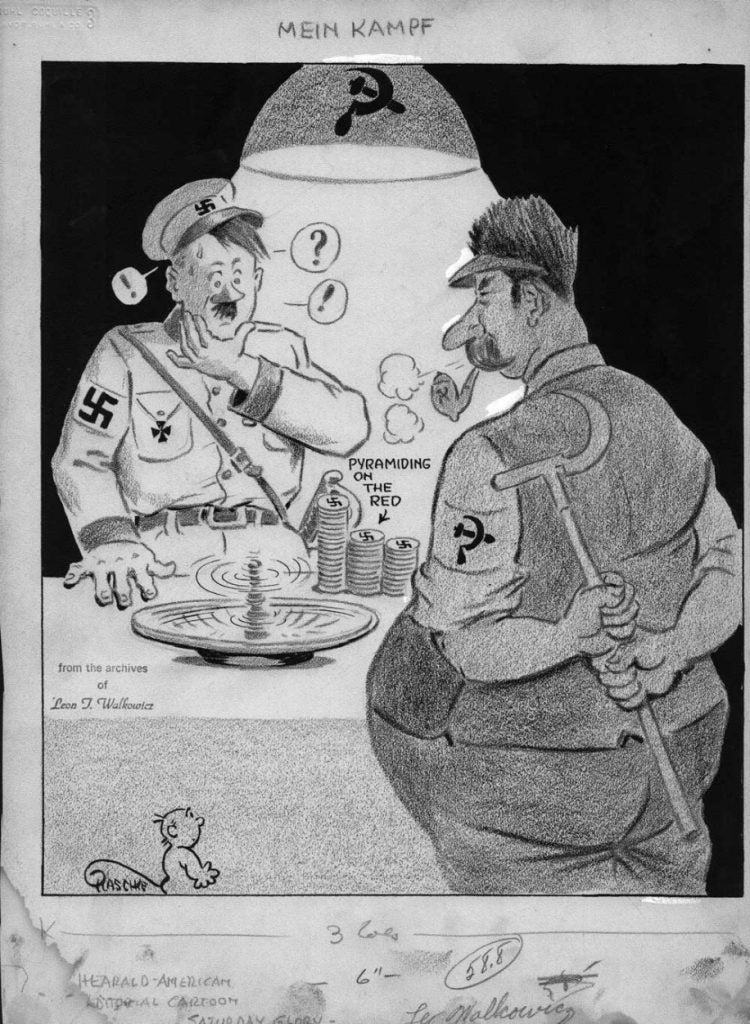
“Mein Kampf” (October 21, 1939)
by Paul Albert Plaschke (1880 – 1954)
24 x 36 in., ink and charcoal on paper
Coppola Collection
The context here is the Molotov–Ribbentrop Non-Aggression Pact, which was signed on August 23, 1939 (Moscow) between Nazi Germany and the Soviet Union. It is named for the two foreign ministers, Joachim von Ribbentrop and Vyacheslav Molotov, who were involved with the negotiation. Germany was already aligned with Mussolini’s Italy, and by the late 1930s its intent toward expansionism was clear.
Stalin was playing both sides: the Soviets were negotiating with Germany at the same time they were in talks with Britain and France. What would not be known for years was that the German-Soviet agreement also included secret provisions for dividing up the Euro-Soviet borderlands (Finland, the Baltics, Poland, and Romania), setting up the nearly immediate German invasion on September 1.
The public message in October is pretty much the same as at the start of the war: overconfidence that this war is not going anywhere. Hitler is taking a risk on this communist alliance (dubbed by Time Magazine as the “Communazi Pact”). Stalin is portrayed as the croupier, and the game is played under the Soviet illumination. Pyramiding is a betting scheme used in roulette where you maintain your bet when you are winning but increase it by an increment when you lose, so there is a skepticism being communicated, here, about Hitler’s wisdom in this partnership – which is being cast as just another front is his battle (Kampf).
It’s unfortunate, to say the least, when this stuff is not taken seriously.