Sarah B. Mills, Ph.D is the Director of Graham’s Center for EmPowering Communities, where she manages UM’s partnership with the Michigan Office of Climate and Energy and helps communities across the state consider energy in their land use planning, zoning, and other policymaking. She is Associate Professor of Practice in Urban and Regional Planning at the Taubman College of Architecture and Urban Planning. Her current work focuses on how renewable energy development impacts rural communities (positively and negatively), the disparate reactions of rural landowners to wind and solar projects, and how state and local policies facilitate or hinder renewable energy deployment.
Interviewer: Lunia E. Oriol
February 2025
Where did you grow up and how did you become interested in energy policy and land use planning?
I grew up at the end of a dirt road in Maybee, Michigan, a small town about 45 minutes or so away from Ann Arbor. How I became interested in energy policy and land use planning is a bit of a non-linear story. My parents own a small lumberyard/ hardware store, and I went to college to study engineering, thinking that I would eventually take over the store. By my senior year of college, however, I wanted to become an environmental ethicist. After graduating with a Bachelor’s in Mechanical Engineering, I completed a Master’s in Engineering for Sustainable Development at the University of Cambridge, then I came back to the U.S. to do some sustainability work.
What led me to land use planning was quitting my job to follow my brand-new husband to Africa, where he was setting up electricity systems in South Sudan (this was during the period between South Sudan’s vote for independence and becoming an independent nation). The entire country was transitioning from communal to private land ownership, and the community we lived in hired me to be the town’s planner to demarcate plots. By this time, the closest thing to planning I had done was taking a survey in an engineering class! In trying to read more about how to be a planner, I realized most of the literature on rural planning was written before I was born. When our time in Africa was done, I came back to study rural planning. The energy and engineering angles arrived a year into my PhD when driving up north. I saw the windfarm (also spelled wind farm) in Gratiot County, which I googled and learned was being portrayed in the community as a farmland preservation tool. Combining engineering and rural planning would finally make my resume make sense.
In 2015, I got my doctorate in Urban and Regional Planning from Taubman College of Architecture and Urban Planning, and my dissertation focused on the social, economic, and land use effects of windfarms on rural landowners and their communities.
What made you choose UM to pursue a doctorate in Urban and Regional Planning?
I knew I wanted to study Midwestern environments and do something that helped the sort of rural communities that I came from. It was ultimately a decision between the University of Michigan (UM) and the University of Wisconsin-Madison. I really liked that UM had the ability to work across campus. I also really appreciated Richard Norton’s work with rural Michigan coastal communities: there are few faculty across the country that are interested in rural planning, and so we’re lucky to have multiple!
Tell us about your current policy research on the impacts of renewable energy development in rural communities, especially on farmland and agricultural communities.
My work is equally divided between research and actively being in rural communities, helping them understand the pros and cons of renewable energy. When I’m not teaching in Taubman, I am the Director of the Center for EmPowering Communities at the Graham Sustainability Institute. We have a small team of staff who help answer questions from local government officials and provide templates for them to advance their communities’ goals with respect to energy and zoning.
While I now see myself as an energy person, many renewable projects happen frequently in farming environments. The land is cheap and plentiful and renewable energy can be a supplemental income for farmers. One of the research projects that we just kicked off is looking at ownership of farmland and the extent to which large-scale solar energy projects are exacerbating, following, or ameliorating trends on absentee investor ownership of farmland. It matters because these largest landowners are the ones who stand to gain the most by having a solar farm on their property, and what we’re trying to understand is what the farmland owners do with the revenue that they receive from leasing their land to solar companies: Do they reinvest in their farm, or do they see this as an opportunity to retire?
One of the unexpected things that we found from our research is that about 70% of solar developers are leasing land from farmland owners, but the other 30% are buying the land, which is something not many people realize. So now, we have energy companies that are owning swaths of farmland, which raises questions about whether that will forever be a site for energy generation. There are even bigger questions about the reversibility from solar back to farmland.
Tell us about Agrophotovoltaics (APV).
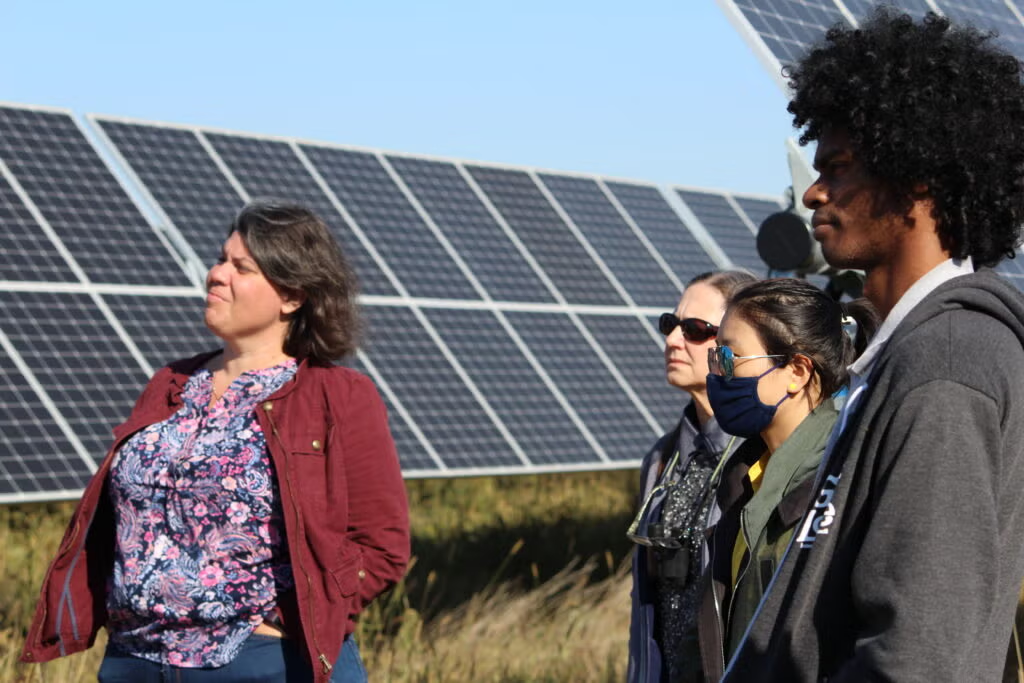
Agrophotovoltaics (or agrivoltaics) is, in the strictest sense, growing food under the solar panels. We conducted a nationwide survey of solar farm neighbors to understand their attitudes towards the solar project in their communities (within 3 miles) and whether attitudes towards APV are different than those towards non-APVs. We didn’t see too much of a difference. The big thing that drives differences in attitude is the scale of the project. Attitudes were generally more positive for smaller projects compared to larger (over a square mile) projects. And because APV projects are pretty small (1–5 acres), it’s really the size of the project–and not the fact that it’s mixing ag and solar–that’s driving the attitudes. And we have a bunch of energy policies and economic considerations that mean small projects are going to be a relatively niche part of our future energy mix.
I’ve been working with a team of engineers and with the folks at the UM Campus Farm for years to try to get an on-campus research facility to study whether and how it is possible to engineer solar projects so that the farming operation and energy generation are coequal. It would include thinking about how to program tilting solar panels to not just follow the sun to maximize energy generation, but determine when to move the panels to give the crops below more sunlight or protection from rain. We’re also considering how these systems might work at a larger scale with farm equipment, rather than just hand harvesting. If we see these projects at a larger scale, then I can study how we can better understand conditions that lead to public acceptance.
How do you like to spend your time when you’re not researching/teaching/working?
I love to spend my time with my family. I live downtown with my husband and our two kids, and people will see us often walking around after dinner. We like to contra dance at the Pittsfield Union Grange. My weekend hobby is cross-stitching while I catch up on work-related podcasts.
I’ve also served on the City of Ann Arbor Planning Commission since 2014. My favorite part of being on the commission is being on the Ordinance Revisions Committee, where we write the first draft of the zoning ordinances that go before the rest of the commission. This work is important because we want to have good laws that we are evaluating projects up against.
Are there any books, documentaries or podcasts that you’ve listened to or read recently?
Right now I’m catching up on webinars, but my favorite podcast is Reimagining Rural, a podcast from The Brookings Institution. A book that is on my to-do list is called The Overlooked Americans: The Resilience of Our Rural Towns and What It Means for Our Country, by Elizabeth Currid-Halkett. I’m also reading a self-help book–Organized Enough–with my 9-year-old who wants to be a “professional organizer” some day, which brings me great joy and some handy tips to organize my office and email inbox.
What is your go-to recipe?
I cook a lot! The other night I made portobello mushroom and sundried tomato lasagna, which was pretty good. Tonight is shrimp fried rice. We bake a lot of apple pies, and my kids like to help me by peeling the apples.
Do you have any advice for students interested in entering the planning field?
- Yes, it is “urban and regional planning”, but there is a whole lot of change that is coming to rural America, and we do not have enough rural planners. I think that the opportunities are wide if you think beyond just an urban environment and begin studying and understanding connections between urban and rural environments.
- Everything is connected. Whether you specialize in land use or transportation, housing or community development, every aspect of planning has an energy angle. Housing units arranged in walkable neighborhoods help reduce transportation energy needs. Smaller housing units, especially those that are attached, take less energy to heat and cool. Jobs within the energy sector play a huge part in local economic development. And it’s critical that we use planners’ expertise in community engagement to help design energy systems that reflect a community’s values.
- Everything is connected. Whether you specialize in land use or transportation, housing or community development, every aspect of planning has an energy angle. Housing units arranged in walkable neighborhoods help reduce transportation energy needs. Smaller housing units, especially those that are attached, take less energy to heat and cool. Jobs within the energy sector play a huge part in local economic development. And it’s critical that we use planners’ expertise in community engagement to help design energy systems that reflect a community’s values.